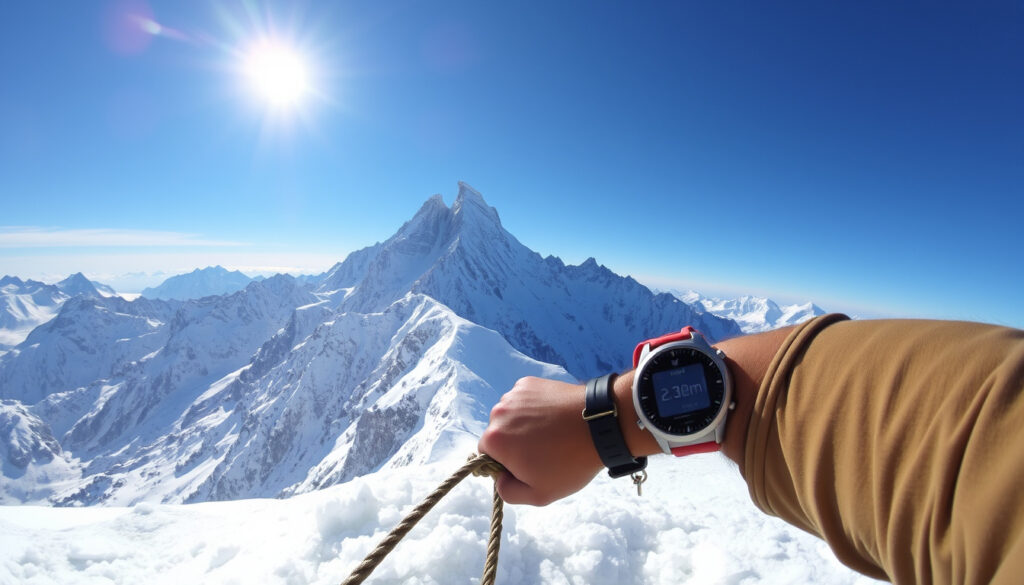
Mont Blanc Climbing: 2pm Rule and Key Facts
Ask a climber what draws them to Mont Blanc, and you’ll hear about more than just altitude — the highest peak in the European Alps is a test of judgment as much as endurance, where the 2pm turnaround rule can make the difference between success and danger. With over 20,000 attempts each year, this 4,808-meter mountain demands respect before ambition.
Elevation: 4,808.73 m (15,777 ft) ·
Location: Border of France and Italy ·
First ascent: August 8, 1786 ·
First ascensionists: Jacques Balmat, Michel-Gabriel Paccard ·
Typical climb duration: 2–3 days
Quick snapshot
- Mont Blanc is the highest peak in the Alps at 4,808.73 m (Wikipedia entry).
- Lies on the border of France and Italy (Wikipedia entry).
- First ascent by Jacques Balmat and Michel-Gabriel Paccard on August 8, 1786 (Wikipedia entry).
- Exact annual attempt numbers vary by source. (La Chamoniarde safety office)
- Long-term climate change impact on route conditions remains debated (La Chamoniarde safety office).
- Since 2019, hut reservations required on normal route June–September (Explore-Share blog).
- Goûter Route suspended due to rockfall in July 2022 (ExplorersWeb report).
- Climate change expected to alter glacier routes further. (Explore-Share blog)
- Stricter safety regulations and guide requirements likely to increase (Explore-Share blog).
Six key facts at a glance — one pattern: the mountain’s statistics tell a story of extreme scale and steady danger.
| Label | Value |
|---|---|
| Elevation | 4,808.73 m (15,777 ft) |
| First ascent | 8 August 1786 |
| Country | France / Italy |
| Nearest city | Chamonix, France |
| Prominence | 4,697 m |
| Annual fatalities | Approx. 100 |
Is Mont Blanc in France or Switzerland?
Where exactly does Mont Blanc lie?
- Mont Blanc sits on the border of France and Italy, not Switzerland (Wikipedia entry).
- The summit itself is in French territory (Wikipedia entry).
- The mountain range extends into Switzerland, but the peak does not.
Mont Blanc is the highest summit in the Graian Alps, a subrange of the Alps that crosses into both countries. The France–Italy border runs along the summit ridge, but the highest point falls on the French side. Many travelers assume Switzerland claims the peak because the Mont Blanc massif stretches north toward the Swiss Valais, but the summit lies roughly 15 km southwest of the Swiss border.
Does Mont Blanc belong to Italy too?
- Italy shares the massif and administers the southeastern slopes.
- The summit is French, but Italy holds the adjacent secondary summit of Monte Bianco di Courmayeur.
- Disputes over the exact border line were settled in 1861 (Wikipedia entry).
The implication for climbers: which country you stand in matters less than which regulatory framework applies. French and Italian hut systems, rescue services, and access rules differ slightly, and the mountain’s summit is governed by French authorities. If you climb from the Italian side via the Miage or Brouillard routes, you still cross into France near the top.
What exactly is Mont Blanc?
What does the name Mont Blanc mean?
- Mont Blanc translates to “White Mountain” in French (Wikipedia entry).
- The name refers to its year-round snow and ice cover.
- In Italian, it is called Monte Bianco, which carries the same meaning.
The name Mont Blanc has been in use since at least the 18th century. Early maps and travelogues refer to the peak by its French name, and the “White Mountain” descriptor reflects the massive glaciers — including the Mer de Glace — that drape its slopes. Unlike many alpine peaks named after their shape or location, Mont Blanc is named for its color and the visual contrast it creates against the surrounding landscape. The name also appears in the brand Montblanc, the luxury pen and watch maker, which took its name from the mountain in 1906.
How high is Mont Blanc?
- The official elevation is 4,808.73 m (15,777 ft) (Wikipedia entry).
- The height fluctuates due to ice cap thickness and seasonal melt.
- It was officially surveyed in 2002, 2007, 2010, 2013, 2015, 2017, 2019, and 2021.
The elevation of Mont Blanc changes by several meters over time because the ice cap at the summit shifts in depth. In 2021, scientists measured the summit at 4,807.81 m — roughly a meter lower than in 2019 — due to reduced snow accumulation. The commonly cited figure of 4,808.73 m remains the reference elevation used by maps and guidebooks. For comparison, that is roughly 2.7 times the height of the Empire State Building and 130 m lower than the highest mountain in the world outside of Asia, Aconcagua.
Mont Blanc’s elevation is not a fixed number — it’s a living measurement. Climbers planning routes should check current conditions through La Chamoniarde safety office rather than relying solely on legacy survey data.
What is famous about Mont Blanc?
Why is Mont Blanc a major mountaineering goal?
- It is the highest mountain in the European Alps (Wikipedia entry).
- It is a classic mountaineering objective with historical significance.
- Over 20,000 climbers attempt the summit annually (Explore-Share blog).
Mont Blanc is Europe’s cradle of alpinism. The first recorded ascent in 1786 by Jacques Balmat and Michel-Gabriel Paccard launched modern mountaineering as a sport and scientific pursuit. Today, it remains one of the most climbed high-altitude peaks in the world, drawing everyone from seasoned alpinists to first-time mountaineers. The massif hosts iconic routes — the Goûter, the Trois Monts, the Italian side’s Miage — each offering a different technical challenge.
What is the cultural significance of Mont Blanc?
- Mont Blanc has inspired literature, film, and art for centuries.
- It appears in works by Romantic poets like Percy Bysshe Shelley and Samuel Taylor Coleridge.
- The mountain also lends its name to the Montblanc luxury brand, though the two are unrelated.
The cultural footprint of Mont Blanc extends well beyond climbing. The mountain’s image appears on everything from Italian chocolate wrappers to luxury watches. The Montblanc brand, founded in Hamburg in 1906, adopted the peak’s name and the six-pointed star logo to symbolize the six glacier valleys radiating from the summit. This commercial borrowing has caused confusion: many travelers searching for “Mont Blanc” online encounter pens and wallets before the actual mountain. The real Mont Blanc — the one that requires crampons and a guide — sits firmly in the Alps and demands a very different kind of investment.
Is it hard to climb Mont Blanc?
What is the difficulty level of the normal route?
- The normal route (Goûter Route) is graded PD (Peu Difficile) — “moderately difficult” (Mountain Dropoffs climbing guide).
- It requires glacier travel, crampons, ice axe, and crevasse-awareness skills.
- Rockfall on the Grand Couloir section presents serious objective danger (ExplorersWeb report).
The PD rating places Mont Blanc at the lower end of technical difficulty among alpine peaks — below the Matterhorn (AD) or the Eiger (D). But the PD grade only captures the technical moves. The real challenges are altitude, weather, and decision-making. As Explore-Share blog notes, most guides accept a maximum of two clients per group, because the mountain’s objective hazards — rockfall, crevasses, sudden storms — demand constant attention.
What training is required?
- Good physical fitness and basic mountaineering skills are essential (Mountain Dropoffs climbing guide).
- Prior experience with crampons, ice axe, and glacier travel is strongly recommended.
- Training plans typically run 3–6 months and include endurance hiking, strength training, and altitude acclimatization.
The fitness bar for Mont Blanc is non-negotiable. Climbers should be able to hike for 6–8 hours at a sustained pace with a 10–15 kg pack at altitudes above 3,000 m. La Chamoniarde safety office recommends a mountain guide for anyone unfamiliar with alpine terrain because the guide can assess objective dangers and manage pacing. Without a guide, the learning curve on the mountain itself is steep and unforgiving.
What is the 2pm rule on Mont Blanc?
- The 2pm rule means you must turn back by 2pm to avoid afternoon storms (TMB Trail Guide safety tips).
- Afternoon heat softens snow, increases rockfall, and triggers thunderstorms.
- Late descents are among the leading causes of accidents on the mountain.
The 2pm rule is the single most important safety protocol on Mont Blanc. Guides enforce it rigidly: if you are not at the summit by 1pm, you turn around regardless of how close you are. The reasoning is grounded in alpine meteorology. Morning freeze keeps snow stable and visibility high. By early afternoon, the sun warms the Grand Couloir, sending rocks tumbling down the gully that climbers must cross. Storms build rapidly above 3,500 m. As TMB Trail Guide safety tips states, starting early — often by 2am from the Cosmiques Hut — is the cornerstone of a safe ascent.
The 2pm rule only works if you start early enough. Climbers who leave the Goûter Hut at 4am or later often find themselves rushing to reach the summit by the cutoff — a pressure that has led to accidents. The real safety margin is built at 2am, not 2pm.
The pattern: strict timing and early starts transform the 2pm rule from a guideline into a reliable safety barrier.
- Hire a certified high-mountain guide.
- Reserve a hut bed (Goûter Hut or Cosmiques Hut) in advance.
- Start summit day by 2am from the hut.
- Turn around by 2pm regardless of progress.
- Check current conditions on La Chamoniarde before departure.
Which city is closest to Mont Blanc?
What is the main town for Mont Blanc climbs?
- Chamonix, France, is the closest major town.
- Chamonix is the primary hub for mountaineering and tourism on the French side.
- The town sits at 1,035 m elevation at the foot of the massif.
Chamonix is the de facto base camp for Mont Blanc. The town hosts guide services, gear shops, hut booking offices, and the indispensable La Chamoniarde safety office where climbers get current conditions and route advice. On the Italian side, Courmayeur serves as the secondary hub, located about 12 km from the summit via the Mont Blanc Tunnel.
How far is Geneva from Mont Blanc?
- Geneva is approximately 88 km from Chamonix.
- The drive takes roughly 1 hour 15 minutes by car.
- Geneva Airport is the most common international entry point for climbers.
Geneva serves as the primary gateway for international climbers flying into the region. The city sits on the western edge of Lake Geneva, about 12 km from the Swiss border with France. Several bus services run direct routes from Geneva Airport to Chamonix during the summer season, and car rental is widely available. The proximity of a major international airport to a 4,800 m alpine peak is unusual — Mont Blanc is among the most accessible high-altitude mountains in the world from a logistics standpoint.
Why is Mont Blanc called the cursed mountain?
What is the history of the name?
- The nickname stems from the high number of fatalities on the mountain.
- It is not an official name, but a colloquial term used in climbing circles.
- The French phrase “montagne maudite” has appeared in media coverage of major accidents.
The “cursed mountain” label is not a historical curse but a grim statistical reality. Mont Blanc records approximately 100 deaths per year, making it one of the deadliest mountains in the world by annual fatalities. The causes are varied: avalanches, falling ice, crevasse falls, exposure, and altitude-related illness. The Grand Couloir alone has claimed dozens of lives. ExplorersWeb report noted that the Goûter Route was temporarily closed in July 2022 because of extreme rockfall danger, a reminder that the mountain’s geology is actively hostile.
Are there many deaths on Mont Blanc?
- Approximately 100 climbers die on Mont Blanc annually (Wikipedia entry).
- Avalanches, falling ice, and crevasses are the main hazards (Mountain Dropoffs climbing guide).
- Many fatalities involve solo climbers or poorly equipped parties.
The annual death toll on Mont Blanc is higher than on Mount Everest in absolute numbers, though the fatality rate per attempt is lower. The mountain’s accessibility means a wide range of experience levels attempt the climb, and many underestimate the objective dangers. Mountain Dropoffs climbing guide identifies altitude sickness, crevasses, rockfall, and rapidly changing weather as the four major hazards. Each season, local guides post warnings about route conditions on the La Chamoniarde safety office website, but the messages do not always reach international climbers planning their trip online.
The “cursed mountain” label is not myth — it is a warning with a data point attached. For the 20,000 climbers who attempt Mont Blanc each year, the difference between a safe summit and a rescue call often comes down to one decision: turn around before conditions turn bad.
Do I need oxygen to climb Mont Blanc?
Can you climb Mont Blanc without supplemental oxygen?
- No, supplemental oxygen is not required for Mont Blanc (Explore-Share blog).
- Most climbers do not use oxygen.
- Good acclimatization is the key to managing altitude on this peak.
Mont Blanc sits at 4,808 m — below the threshold where supplemental oxygen becomes necessary for most healthy adults. The typical summit day involves climbing from the Goûter Hut (3,835 m) or Cosmiques Hut (3,613 m) to the top and descending, spending roughly 6–10 hours above 3,500 m. That altitude range produces noticeable hypoxia — reduced oxygen saturation — but the body can adapt with proper acclimatization. Explore-Share blog notes that most guides recommend spending at least two nights above 3,000 m before summit day to reduce the risk of altitude sickness.
At what altitude does altitude sickness start?
- Altitude sickness can begin above 2,500 m (Wikipedia entry).
- At 3,500 m+ symptoms become common in unacclimatized climbers.
- Acute Mountain Sickness (AMS) affects up to 50% of climbers at 4,000 m.
The summit elevation of Mont Blanc is high enough to cause altitude symptoms in most first-time climbers. Headache, nausea, reduced appetite, and disrupted sleep are typical. Severe AMS — with confusion, ataxia, or pulmonary symptoms — requires immediate descent. The mountain’s huts provide a gradual acclimatization profile if you follow the 2–3 day itinerary: sleep in Chamonix (1,035 m), move to the Goûter or Cosmiques Hut (3,600–3,800 m) for one night, then summit. Skipping the hut night and trying a single-push ascent from Chamonix is possible but significantly increases AMS risk.
Clarity check: what we know and what remains uncertain
Confirmed facts
- Mont Blanc is the highest peak in the Alps at 4,808.73 m (Wikipedia entry).
- The mountain lies on the border of France and Italy (Wikipedia entry).
- First ascent by Balmat and Paccard in 1786 (Wikipedia entry).
- Over 100 fatalities per year (Wikipedia entry).
- Hut reservations have been required on the normal route since 2019 (Explore-Share blog).
- The 2pm rule is a standard safety protocol enforced by guides (TMB Trail Guide safety tips).
What’s unclear
- Exact annual attempt numbers vary by source — some estimate 20,000, others 30,000.
- The precise impact of climate change on long-term route stability is still being studied (La Chamoniarde safety office).
- Whether future regulations will require guides for all climbers remains under discussion among French and Italian authorities (Explore-Share blog).
Voices from the mountain
I saw that the summit was within reach, and I could not turn back. We pressed on through the snow and ice, and at last stood upon the highest point of Europe — a moment I shall never forget.
— Jacques Balmat, first ascensionist of Mont Blanc, 1786 (Wikipedia entry)
The 2pm rule is not just a suggestion — it is a lifeline. By midday, the sun has softened the snow, rocks begin to fall, and storms can build in minutes. If you are not on your way down by 2pm, you are gambling with conditions that have killed too many climbers.
— Chamonix mountain guide, citing protocols from La Chamoniarde safety office
The normal route became too dangerous for our teams. We had no choice but to suspend operations until conditions stabilize. The mountain decides when we can climb, not the calendar.
— Compagnie des Guides de Chamonix, July 2022, as reported by ExplorersWeb report
Summary
Mont Blanc is not a mountain you conquer — it is a mountain you negotiate with. Between the 2pm rule, the rockfall risk, the altitude, and the weather, every climb involves a series of small trade-offs between ambition and survival. The data — 100 deaths per year, over 20,000 attempts, a seasonal fatality rate that rivals any peak in the world — makes one thing clear: respect the protocols or do not go. For the climber flying into Geneva, booking a hut, and lacing up crampons for the first time, the choice is straightforward: hire a guide, start early, turn around at 2pm, or find another mountain.
facebook.com, responsiblevacation.com, reddit.com, youtube.com, lifehappensoutdoors.com, montblanctreks.com
Frequently asked questions
Can you see Mont Blanc from Switzerland?
Yes, Mont Blanc is visible from several high vantage points in western Switzerland, including the Jura Mountains and certain peaks in the Valais. The view is clearest from the Aiguille du Midi cable car or from Mont Blanc itself, but the summit is not visible from most Swiss cities at low elevation.
What is the best time of year to climb Mont Blanc?
The standard climbing season runs from June through September. July and August offer the most stable weather but also the highest traffic on the Goûter Route. Late June and early September provide fewer crowds but more variable snow conditions. Check current conditions through La Chamoniarde safety office before planning your trip.
Do you need a guide to climb Mont Blanc?
Technically, no — independent ascents are allowed. Practically, most safety organizations strongly recommend a guide for any climber without extensive alpine experience. La Chamoniarde safety office explicitly advises hiring a certified high-mountain guide to manage route selection, pacing, and objective hazard assessment.
Is Mont Blanc harder than Mount Everest?
No. Everest is far more demanding — higher altitude, longer commitment, greater objective danger, and significantly more complex logistics. Mont Blanc is a technical alpine climb graded PD (moderately difficult) with a summit altitude of 4,808 m, whereas Everest is an 8,848 m expedition peak requiring supplemental oxygen, months of preparation, and Sherpa support. The death rate per attempt is actually lower on Everest than on Mont Blanc when adjusted for traffic.
How long does it take to walk around Mont Blanc?
The Tour du Mont Blanc, a 170 km hiking circuit that loops around the massif through France, Italy, and Switzerland, typically takes 10 to 12 days to complete. It is considered one of the world’s classic long-distance treks and does not require mountaineering equipment.
Is there a cable car to the top of Mont Blanc?
No cable car reaches the summit itself. The Aiguille du Midi cable car from Chamonix ascends to 3,842 m, within striking distance of the summit but still requiring a full glacier climb with crampons and guide. The Skyway Monte Bianco on the Italian side reaches 3,466 m at Punta Helbronner.
Does Mont Blanc have a glacier?
Yes — Mont Blanc is covered by several major glaciers, including the Mer de Glace, the Bossons Glacier, and the Taconnaz Glacier. The Mer de Glace is the largest glacier in France, stretching 12 km down the northern side of the massif. Climate change has caused significant retreat of these glaciers in recent decades.
More related posts
 Gamification Summit Ticket Sale Effectiveness: Top Strategies
 The Boy in the Striped Pajamas – Book Movie Facts and Controversy
 Canadian Dollar Rate Today in India: Live CAD to INR
 Jobs Near Me Since Yesterday: Urgent Kilkenny Openings
 Ricky Hatton’s Death: Inquest, CTE, and Family Legacy
 Prairies Winter Storm Warnings – Latest Snow and Travel Alerts
 When Is Mother’s Day Canada 2025? Date, History & More
 Carlo Acutis: Life, Miracles, and Canonization