The Boy in the Striped Pajamas – Book Movie Facts and Controversy
The Boy in the Striped Pajamas has become a fixture in educational curricula since its 2006 debut, yet it remains one of the most contentious novels addressing the Holocaust. John Boyne’s story of friendship between a Nazi commandant’s son and a Jewish prisoner has sold millions of copies while drawing sharp criticism from historians for its approach to historical atrocity.
Set against the backdrop of Auschwitz in 1943, the narrative follows nine-year-old Bruno, whose father’s military promotion forces the family from Berlin to a lonely house adjacent to a concentration camp. Through Bruno’s innocent eyes, readers witness the horror of the Holocaust filtered through childhood incomprehension, creating a work that generates passionate debate regarding its educational value and historical responsibility.
What is The Boy in the Striped Pajamas About?
John Boyne
2006 (novel), 2008 (film)
Historical fiction, Holocaust literature
Auschwitz-Birkenau, 1943
- The narrative employs a child’s limited perspective to explore Holocaust horror without graphic depictions.
- Bruno mispronounces critical terms—Auschwitz becomes “Out-With” and Hitler becomes “the Fury”—emphasizing his naivety.
- The friendship between Bruno and Shmuel transcends the barbed wire fence separating the commandant’s home from the concentration camp.
- Historical critics note significant inaccuracies, including the impossibility of a nine-year-old Jewish boy surviving at Auschwitz.
- The work has achieved massive commercial success alongside severe academic criticism.
- Both book and film conclude with the protagonists dying in a gas chamber.
| Attribute | Details |
|---|---|
| Original Publisher | David Fickling Books |
| Page Count | 216 pages (hardcover) |
| Film Runtime | 94 minutes |
| Primary Setting | Outside Auschwitz concentration camp, 1943 |
| Protagonists | Bruno (German, age 9) and Shmuel (Jewish prisoner, age 9) |
| Shared Birthday | April 15, 1934 (both boys) |
| Major Awards | Irish Book Award Children’s Book of the Year (2006), Bisto Book of the Year (2007), Irish Book of the Year (2008) |
| Film Director | Mark Herman |
| Film Cast | Asa Butterfield, Jack Scanlon, David Thewlis, Vera Farmiga |
| Sequel | All the Broken Places (2022) |
Who Are the Central Characters?
Bruno serves as the naive narrator, the eight-year-old (turning nine) son of a high-ranking SS officer. Sheltered from political realities, he processes his new environment through a lens of childhood confusion. Referencing plot analyses, Bruno’s mispronunciations—”Out-With” for Auschwitz and “the Fury” for the Führer—demonstrate his disconnection from the atrocities surrounding him.
Shmuel represents the Jewish experience within the camp, a nine-year-old prisoner who shares Bruno’s birthday but inhabits a world of starvation and fear. Shmuel lives with his father, grandfather, and brother before being separated from the women in his family, enduring daily brutality while maintaining a polite demeanor during his clandestine meetings with Bruno.
Where Does the Story Take Place?
The narrative unfolds primarily at the Auschwitz-Birkenau complex, though the camp is never explicitly named within the text, remaining “Out-With” through Bruno’s misunderstanding. The family resides in a comfortable house located impossibly close to the camp’s electrified fence—a geographical liberty that has drawn significant criticism from historians who note that commandant residences were situated farther from the killing centers.
Is The Boy in the Striped Pajamas Based on a True Story?
The novel is explicitly a work of historical fiction, not a memoir or biographical account. John Boyne invented the characters of Bruno and Shmuel, their friendship, and the specific circumstances of the plot. While the setting draws from the real operations of Auschwitz-Birkenau during 1943, including references to gas chambers and starvation, the central narrative conceit remains entirely fictional.
No historical records document a nine-year-old German commandant’s son befriending a Jewish prisoner at Auschwitz. The story functions as a fable rather than documentary, utilizing the Holocaust as a backdrop for exploring themes of innocence and complicity rather than providing factual history.
Boyne has defended his work as a “fable,” arguing that the story’s power lies in its emotional impact rather than historical pedagogy. However, historical assessments note that the novel contains significant anachronisms and impossibilities, including the survival of a young child at Auschwitz when the camp’s implemented policy immediately gassed those unable to work.
Who Wrote The Boy in the Striped Pajamas and When Was It Published?
Irish author John Boyne penned the novel in 2006, completing the first draft in approximately two and a half days according to interviews. Published by David Fickling Books, the work quickly attained bestseller status, subsequently translated into over 50 languages and adapted into a major motion picture by 2008.
Boyne, born in Dublin in 1971, had previously written adult fiction before creating this young adult novel. He conducted research on Auschwitz operations, though critics argue he prioritized narrative convenience over historical accuracy in depicting camp life and security protocols.
The book received immediate recognition, winning the Irish Book Award Children’s Book of the Year in 2006, followed by the Bisto Book of the Year in 2007 and the overarching Irish Book of the Year in 2008. Literary analyses suggest the novel’s rapid success stemmed from its accessibility to younger readers approaching Holocaust history for the first time.
In 2022, Boyne published “All the Broken Places,” a sequel examining Gretel’s adulthood decades after the war. This follow-up addresses the long-term psychological trauma experienced by the commandant’s daughter, exploring her guilt and attempts to conceal her family history while raising a son who discovers her past.
What Happens at the End of The Boy in the Striped Pajamas?
The conclusion delivers devastating irony as Bruno’s plan to help Shmuel locate his missing father leads directly to their deaths. After smuggling a pair of striped prisoner pajamas to Bruno, Shmuel helps his friend crawl beneath the fence—a breach that historians note would have been impossible given actual Auschwitz security measures.
Once inside, the boys become caught in a group march heading toward a “shower.” Holding hands in the darkened gas chamber, they die together as the doors seal and Zyklon B is introduced, remaining unaware of their fate until the final moments.
Bruno’s disappearance triggers a frantic search by his mother Elsa, who eventually returns to Berlin with Gretel. According to plot summaries, Ralf discovers his son’s discarded clothes outside the fence and realizes Bruno entered the camp. The commandant collapses in grief, subsequently abandoning his military duties and allowing himself to be captured by Allied forces without resistance, effectively surrendering to his devastation.
Book vs Movie: Key Differences in The Boy in the Striped Pajamas
Mark Herman’s 2008 film adaptation starring Asa Butterfield, Jack Scanlon, David Thewlis, and Vera Farmiga remains largely faithful to Boyne’s narrative while introducing specific visual elements that clarify plot mechanics. Film data confirms the movie maintains the novel’s tragic tone and naive perspective while adding scenes that explain logical gaps present in the original text.
Key distinctions include the film’s explicit depiction of Gretel’s Nazi indoctrination, visualized through propaganda posters and her attraction to a young lieutenant, which remains more subtle in the novel. Additionally, the movie includes a lice-shaving scene that explains why Bruno possesses a shaved head when he dons the prisoner pajamas—a practical detail absent from the book but necessary for visual continuity in the film medium.
The cinematic version earned a PG-13 rating for mature thematic material involving violence and implied gas chamber sequences, while the book is generally cataloged for ages ten and up, though reviewers recommend parental guidance due to the Holocaust content and tragic conclusion.
How Did The Boy in the Striped Pajamas Enter the Cultural Consciousness?
- : John Boyne publishes the novel with David Fickling Books, winning the Irish Book Award Children’s Book of the Year.
- : The novel receives the Bisto Book of the Year award as sales continue expanding internationally.
- : Publication wins Irish Book of the Year; Miramax releases the film adaptation directed by Mark Herman.
- : The book enters widespread classroom use in the United States and United Kingdom, generating early debates about historical accuracy.
- : Educational adoption peaks while Holocaust historians intensify criticism regarding the work’s suitability as historical instruction.
- : Boyne publishes sequel “All the Broken Places,” returning to the narrative through Gretel’s adult perspective.
Publication records and educational analyses confirm these milestones.
What Are the Facts Versus Common Misconceptions?
| Established Information | Unclear or Misunderstood Aspects |
|---|---|
| Fictional novel by John Boyne, published 2006 | Often mistakenly assumed to be based on true events or a memoir |
| Film adaptation released 2008 with PG-13 rating | Exact age appropriateness remains debated among educators |
| Set during 1943 at Auschwitz-Birkenau | Geographic liberties taken with commandant house proximity to camp |
| Protagonists die in gas chamber | Historical impossibility of a child survivor living months at Auschwitz |
| Won multiple Irish literary awards | Extent of author’s historical research methodology |
Why Does The Boy in the Striped Pajamas Remain Historically Controversial?
Academic criticism centers on the novel’s fundamental historical impossibilities. Auschwitz historians emphasize that children under fifteen were typically sent immediately to gas chambers upon arrival, making Shmuel’s extended survival inside the camp fictional rather than representative. Educational reviewers note that the fence surrounding Auschwitz incorporated multiple security measures including electrification and guard towers, rendering Bruno’s casual crawling underneath an egregious inaccuracy.
Critics further argue that the narrative humanizes the perpetrators through Bruno’s innocent gaze while reducing Jewish victims to passive figures awaiting rescue. While some media portrayals balance entertainment with education, such as The Last of Us Eugene, the Auschwitz-Birkenau Memorial and Museum has publicly cautioned against using Boyne’s book as educational material, suggesting it creates a misleading portrayal of camp conditions and survivor experiences.
Boyne maintains that he wrote a fable exploring moral complicity rather than a documentary record. However, the book’s widespread use in schools has led to concerns that students may internalize inaccuracies about Holocaust operations, potentially minimizing the industrial scale of genocide by framing it through an implausible friendship narrative.
What Do Critics and Scholars Say About the Work?
The novel represents a perverse distortion of Holocaust history that dangerously humanizes the perpetrators while sanitizing the systematic murder of millions through a narrative of childhood innocence.
— Historical criticism aggregate, Auschwitz-Birkenau Memorial assessments
I approached this story as a fable, not as a historical textbook. The intention was never to document Auschwitz procedures but to explore how innocence confronts evil when that evil is normalized by adult society.
— John Boyne, author interviews
Should You Read The Boy in the Striped Pajamas?
The Boy in the Striped Pajamas functions most effectively as an emotional introduction to Holocaust themes for readers too young for explicit historical documentation. While not comparable to animated family features like the Cast of Madagascar 2005, it offers a distinct approach to historical tragedy that requires careful educational framing. Readers seeking accurate historical accounts should supplement this work with survivor testimonies and scholarly histories, treating Boyne’s narrative as a conversation starter rather than definitive documentation of Auschwitz operations.
Frequently Asked Questions
Why is it called The Boy in the Striped Pajamas?
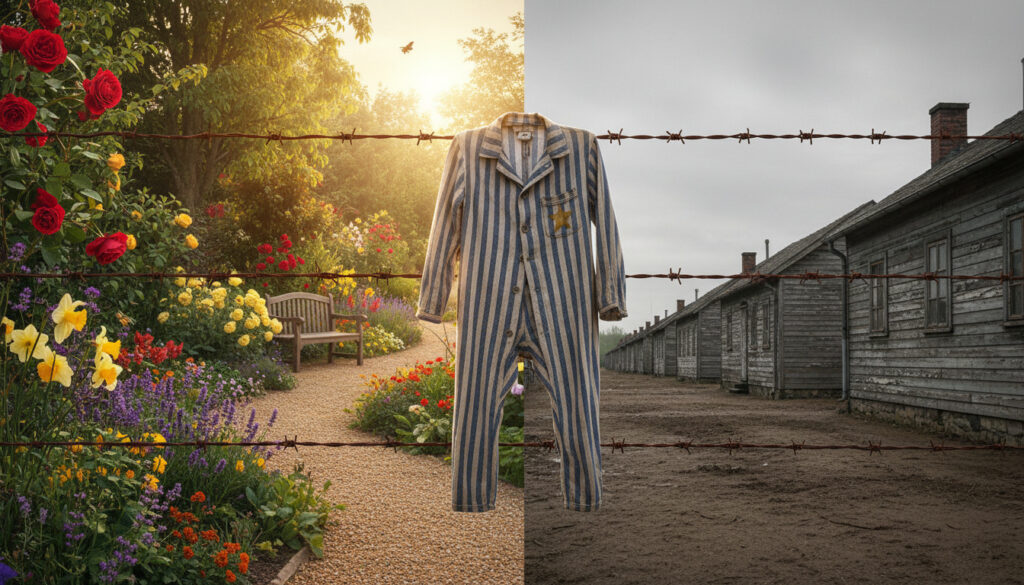
The title refers to the striped prisoner uniforms worn by Jewish inmates at Nazi concentration camps. Bruno, the young protagonist, mistakes these uniforms for pajamas due to his naive misunderstanding of the camp’s true nature.
What are the main themes of the story?
Central themes include innocence confronting institutional evil, the dangers of willful ignorance, friendship transcending social barriers, and the complicity of ordinary individuals in systematic atrocities. The narrative explores how adult prejudices poison childhood through a child’s limited comprehension.
Is there controversy around using the book in schools?
Yes. Holocaust historians and the Auschwitz-Birkenau Memorial oppose its educational use, citing historical inaccuracies including the impossible survival of a nine-year-old prisoner and unrealistic fence security. Critics argue it humanizes Nazis while distorting Jewish victim experiences.
What awards did the book win?
The novel received the Irish Book Award Children’s Book of the Year (2006), Bisto Book of the Year (2007), and Irish Book of the Year (2008). The film adaptation earned British Independent Film Award nominations.
Is the movie available on Netflix?
Streaming availability varies by region and licensing agreements. The 2008 film starring Asa Butterfield periodically appears on Netflix, Amazon Prime Video, and other platforms, though subscribers should verify current catalogs directly.
What age rating applies to the movie?
The film carries a PG-13 rating for mature thematic material involving violence and Holocaust imagery. The book targets ages ten and up, though educators recommend adult guidance due to the tragic ending and historical content.
More related posts
 When Does Daylight Savings Time End 2025 – Nov 2 at 2 a.m.
 18 kg to lbs: How Many Pounds is 18 Kilograms? (39.683 lb)
 100 Fahrenheit to Celsius: Converter, Formula & Guide
 Vivienne Jolie-Pitt: Bio, Family, Name Change News
 CM Stock Price TSX Today: CIBC Buy or Sell Forecast
 Jobs Near Me Since Yesterday: Urgent Kilkenny Openings
 160 CAD to USD Today: Live Converter & Exchange Rate
 IT Cosmetics CC Cream Review: Best for Mature Skin