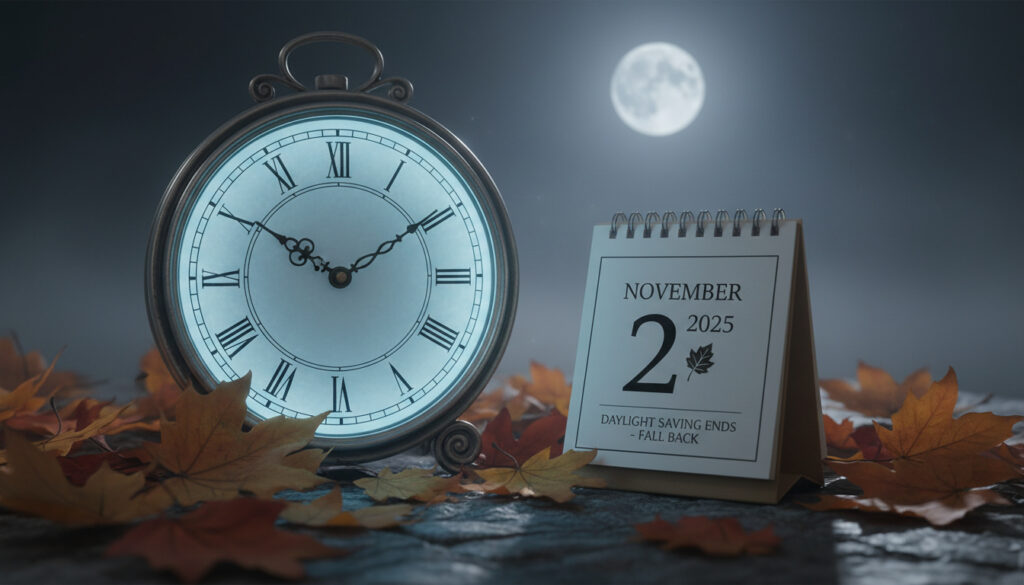
When Does Daylight Savings Time End 2025 – Nov 2 at 2 a.m.
Daylight Saving Time concludes in 2025 on Sunday, November 2, at 2:00 a.m. local time, when clocks shift backward one hour to standard time. This annual transition marks the return to darker evenings and the restoration of the hour lost when DST began in March.
The 2025 schedule follows the pattern established by federal law nearly two decades ago. Official guidance confirms that the change occurs simultaneously across all observing time zones, though the local time of the shift varies from Eastern to Pacific.
For most Americans, this adjustment means an extra hour of sleep and earlier sunsets beginning November 3. Understanding the precise mechanics of the time change helps prevent scheduling errors for travel, work, and automated systems.
When Does Daylight Saving Time End in 2025?
| Event | Date | Time | Impact |
|---|---|---|---|
| DST End | November 2, 2025 | 2:00 AM local | Clocks back 1 hour; extra evening light ends |
| DST Start | March 9, 2025 | 2:00 AM local | Clocks forward 1 hour; more morning light |
| Observing States | 48 contiguous states | N/A | Standard rules apply; Arizona/Hawaii exempt |
| Federal Law | Energy Policy Act 2005 | First Sunday Nov | No change proposed; ongoing debate |
- The exact transition moment occurs at 2:00 a.m., instantly becoming 1:00 a.m. local standard time.
- November 2 represents the first Sunday in November, the federally mandated endpoint.
- March 9, 2025, marks the corresponding start date on the second Sunday in March.
- DST spans approximately 34 weeks, covering 65 percent of the calendar year.
- Five U.S. territories and two states remain exempt from all time changes.
- The U.S. Department of Transportation retains authority over time zone boundaries and DST observance.
- The subsequent cycle begins March 8, 2026, maintaining the established seasonal rhythm.
| Fact | Details |
|---|---|
| End Date | Sunday, November 2, 2025 (first Sunday) |
| Change Time | 2:00 a.m. becomes 1:00 a.m. local time |
| Direction | Fall back one hour |
| Start Date | Sunday, March 9, 2025 |
| Duration | 238 days (approximately 34 weeks) |
| Legal Basis | Energy Policy Act of 2005 |
| Exemptions | Hawaii, Arizona (except Navajo Nation), and five territories |
| Governing Body | U.S. Department of Transportation |
| Next End Date | November 1, 2026 |
Federal law mandates these specific dates nationwide. Historical records document the standardization efforts that created the current biannual system.
Daylight Saving Time 2025 Full Schedule
The Spring Forward Transition
DST begins on the second Sunday in March, which falls on March 9 in 2025. At 2:00 a.m. local time, clocks advance to 3:00 a.m., effectively shifting one hour of daylight from morning to evening. This adjustment affects approximately 48 states and the District of Columbia, creating uniformity across four time zones.
The spring change often disrupts sleep patterns more severely than the fall transition. Medical studies associate the March shift with temporary increases in cardiac events and traffic accidents, though individual impacts vary significantly.
The Fall Back Procedure
The November 2 conclusion reverses the March adjustment. Clocks retreat from 2:00 a.m. to 1:00 a.m., granting the illusion of an additional hour during the night shift for workers on duty. This restoration aligns solar time more closely with standard time, reducing morning darkness during winter months.
Smartphones, tablets, and computers connected to the internet typically adjust automatically at 2:00 a.m. local time. However, manual clocks, appliances, and vehicle dashboards require physical adjustment. The U.S. Naval Observatory confirms that precise time signals synchronize networked devices nationwide.
Which US States and Areas Skip DST?
Exempt States
Hawaii opted out of DST entirely in 1967, citing minimal variation in daylight hours throughout the year. Arizona followed in 1968, with the exception of the Navajo Nation, which observes DST to maintain consistency across its reservation lands that extend into Utah and New Mexico. The Hopi Nation, entirely surrounded by the Navajo reservation, does not observe the time change, creating complex temporal boundaries within northeastern Arizona.
Exempt Territories
Five U.S. territories maintain standard time year-round: American Samoa, Guam, the Northern Mariana Islands, Puerto Rico, and the U.S. Virgin Islands. These locations remain fixed on their respective time zones without seasonal adjustment. Current exemptions remain limited to these specific jurisdictions under the Uniform Time Act of 1966.
Will DST Rules Change or End in 2025?
The Sunshine Protection Act Status
Legislation to establish permanent DST nationwide passed the Senate unanimously in March 2022. The Sunshine Protection Act subsequently stalled in the House of Representatives, never reaching a floor vote before the congressional term expired. The bill was reintroduced in both chambers during January 2025, though no committee hearings or votes have occurred as of the current date.
Despite reintroduction in January 2025, the Sunshine Protection Act has not advanced to a vote in either chamber. Current reporting indicates no imminent federal action to alter the biannual schedule.
State-Level Legislative Efforts
Multiple states have enacted legislation expressing intent to adopt permanent DST upon federal approval. Florida passed such a measure in 2018; California voters approved Proposition 7 the same year. Tennessee, Oregon, Georgia, Colorado, and Massachusetts have passed similar resolutions or bills between 2019 and 2023. However, the 1966 Uniform Time Act prohibits states from unilaterally implementing year-round DST, requiring congressional action to amend the statute.
While Florida, California, and Massachusetts have passed state-level measures favoring permanent DST, these await congressional approval to amend the 1966 Uniform Time Act. No state can unilaterally adopt year-round daylight saving time under current federal law.
Historical legislative analysis demonstrates that previous attempts to modify DST dates required extensive federal coordination to prevent interstate commerce disruptions.
Daylight Saving Time Timeline: From 1918 to 2025
- 1918: The United States first implements DST to conserve resources during World War I, following European precedents.
- 1966: The Uniform Time Act establishes standardized DST dates nationwide, ending the patchwork of local observance.
- 2005: Congress passes the Energy Policy Act, extending DST by four to five weeks beginning in 2007.
- 2007: The current schedule—second Sunday in March to first Sunday in November—takes effect.
- 2022: The Sunshine Protection Act passes the Senate but expires in the House without becoming law.
- DST begins for the 2025 cycle.
- DST ends, returning to standard time.
What Is Certain About 2025 DST?
| Established Facts | Remaining Uncertainties |
|---|---|
| November 2, 2025, at 2:00 a.m. marks the definitive end date. | Congressional passage of permanent DST legislation remains unscheduled. |
| Biannual changes continue unless Congress amends the 1966 Act. | State-level permanent DST bills await federal approval with no timeline. |
| Hawaii and most of Arizona maintain permanent standard time. | Potential health impact studies may influence future legislative priorities. |
| The 34-week DST duration covers approximately 65 percent of the year. | International coordination regarding time observance continues evolving. |
The Legal Framework Behind DST Changes
The Uniform Time Act of 1966 established the modern framework for daylight saving time, granting the U.S. Department of Transportation authority over time zone boundaries and observance rules. This legislation created the option for states to exempt themselves entirely, as Hawaii and Arizona subsequently did. Federal transportation officials maintain that synchronized time observance supports commerce, transportation safety, and broadcast scheduling.
The Energy Policy Act of 2005 modified the original schedule, shifting the start date from April to March and the end date from October to November. These changes, effective 2007, added approximately one month of DST annually based on energy consumption studies. Highway 11 Closure Today – No Active Closures in Ontario demonstrates how transportation systems coordinate across temporal boundaries, similar to the standardized approach required for DST implementation.
Current federal law maintains standard time as the baseline, treating DST as the optional deviation. Any transition to permanent DST would require statutory amendment to redefine standard time itself or authorize states to remain on advanced time year-round.
Official Sources and Expert Verification
The official time for the United States is maintained by the Time Service Department of the U.S. Naval Observatory. Precise time signals ensure that computerized systems transition accurately at 2:00 a.m. local time during DST changes.
— U.S. Naval Observatory Time Service
Official time synchronization for government and financial systems originates from time.gov, operated by the National Institute of Standards and Technology. This source provides the authoritative reference for the moment when 2:00 a.m. becomes 1:00 a.m. on November 2, 2025. NIST physicists maintain atomic clocks that define the legal time standards for federal regulation.
Final Reminder: November 2, 2025
The conclusion of Daylight Saving Time occurs definitively on Sunday, November 2, at 2:00 a.m. local time, with clocks returning to standard time. While legislative debates continue regarding permanent adoption, the biannual schedule remains binding for 2025. Prairies Winter Storm Warnings – Latest Snow and Travel Alerts illustrates how precise timing affects travel and safety notifications, emphasizing the importance of accurate timekeeping as winter approaches and evenings darken earlier.
Common Questions About DST 2025
Do smartphones automatically update when DST ends?
Most internet-connected devices adjust automatically at 2:00 a.m. local time. However, verify settings on older devices or those without network connections to ensure accuracy.
What areas of Arizona observe DST?
The Navajo Nation territory within Arizona follows DST. The Hopi Nation, entirely surrounded by the Navajo Nation, does not observe the time change.
Why does DST end on the first Sunday in November?
The Energy Policy Act of 2005 established this date to extend daylight hours during Halloween and reduce energy consumption. The change took effect in 2007.
Will permanent DST happen in 2025?
No. Despite state-level support and Senate passage in 2022, federal legislation remains stalled. The 2025 schedule follows standard biannual changes.
How does the time change affect international travel?
Time zone differences shift by one hour relative to non-observing countries. Verify flight schedules for November 2 departures or arrivals.
What happens if I forget to change my clocks?
You gain an hour of sleep but may arrive early to appointments. Electronic calendars typically adjust automatically if time zone settings are correct.
More related posts
 Most Famous Person in the World – Polls, Followers and Rankings
 Nike Shoes for Men – Best 2024 Picks for Running and Comfort
 Courage the Cowardly Dog – History Characters Episodes Guide
 Translate Ukrainian to English – Best Free Tools 2025
 Calgary to Vancouver Drive: Road Trip Guide & Best Stops
 No Knead Bread Recipe: 2-Hour & 24-Hour Methods
 Find My Phone Android: Locate Your Lost Device Fast
 Thor Love and Thunder: Hit, Flop & LGBTQ Controver y