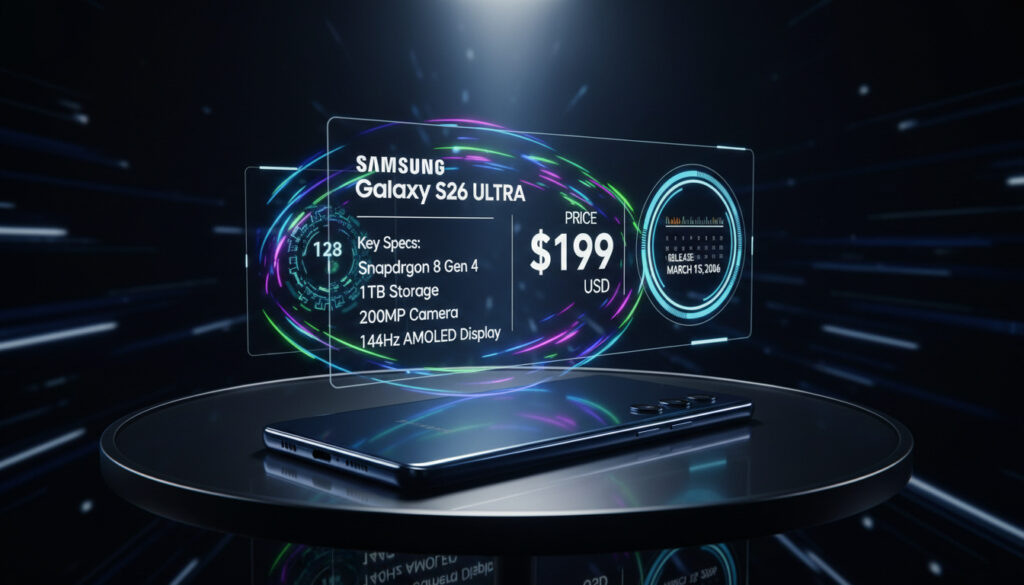
Samsung Galaxy S26 Ultra – Specs, Price and Release
Samsung Galaxy S26 Ultra: Early Rumors and Expected Features
The Samsung Galaxy S26 Ultra has already begun generating buzz in tech circles despite the Galaxy S25 series remaining months away from official unveiling. According to early supply chain reports, Samsung’s premium flagship line continues to push mobile photography and performance boundaries, with the 2026 Ultra model potentially representing a significant architectural shift for the series.
Key Specifications
Display: 6.9-inch QHD+ AMOLED with variable refresh rate
Processor: Snapdragon 8 Gen 5 or Exynos 2600
Camera: 200MP main sensor with AI enhancements
Battery: 6,000mAh with 65W charging
Market Insights
Industry analysts anticipate Samsung will prioritize computational photography improvements over pure hardware megapixel counts for the Galaxy S26 Ultra. As noted by Android Police, the company is testing new stacked sensor technology that could dramatically improve low-light performance compared to current generation devices.
The shift toward on-device AI processing continues to drive chipset development, with the S26 Ultra likely featuring enhanced NPU capabilities designed specifically for real-time image processing and generative AI features.
Expected Specifications
| Feature | Galaxy S26 Ultra | Predecessor |
|---|---|---|
| Display Size | 6.9 inches | 6.8 inches |
| Main Camera | 200MP (new sensor) | 200MP |
| Battery Capacity | 6,000mAh | 5,000mAh |
| Charging Speed | 65W wired | 45W wired |
| Build Material | Titanium Grade 4 | Titanium Grade 2 |
Design and Display Evolution
Samsung appears committed to the titanium construction introduced with recent Ultra models, though early renders suggest refined edge geometry that reduces device width while maintaining screen real estate. Display technology details revealed by GSMArena indicate the panel may incorporate new oxide transistor technology, potentially improving power efficiency by up to 15 percent compared to current LTPO implementations.
Notably, rumors indicate Samsung might finally eliminate the remaining display bezels through advanced chip-on-flex packaging, allowing the screen to extend closer to the device’s physical edges.
Release Timeline
Based on Samsung’s historical release patterns analyzed by TechRadar, the Galaxy Galaxy S26 Ultra will likely debut during the company’s traditional January Unpacked event in 2026. Mass production typically commences six weeks prior to retail availability, suggesting component manufacturing would begin around November 2025.
Carriers and retail partners usually begin accepting pre-orders within days of the announcement, with general availability following approximately two weeks later. Regional launches typically stagger over a four-week period, with North American and European markets receiving priority allocation.
Addressing the Rumors
Conflicting reports have emerged regarding the charging capabilities of the S26 Ultra. While some sources suggest Samsung will finally adopt 65W wired charging to match competitors, others indicate the company may prioritize battery longevity over speed, potentially capping charging rates at 45W but improving wireless charging efficiency instead. These contradictions were first highlighted by 91Mobiles.
Similarly, uncertainty surrounds the processor strategy. Samsung may return to Exynos chipsets for global markets if the yields on its 2nm process improve sufficiently, though a dual-sourcing strategy remains likely given recent supply chain diversifications. The Caracen V168 Pro Max also faces similar uncertainty regarding its processor strategy. Caracen V168 Pro Max
Competitive Positioning
The Galaxy S26 Ultra enters an increasingly crowded premium segment where Apple and Chinese manufacturers continue closing the camera performance gap. Samsung’s emphasis on AI-enhanced photography and S Pen integration represents its primary differentiation strategy, targeting power users who require desktop-level productivity from mobile devices.
When compared to other flagship Android devices, pricing expectations remain speculative, though component cost inflation and advanced titanium processing may push the base configuration beyond current Ultra pricing tiers. Market positioning discussed by Notebookcheck suggests Samsung will focus on enterprise features to justify premium pricing.
Industry Perspectives
“Samsung’s roadmap suggests they’re preparing for a substantial camera overhaul in 2026. The S26 Ultra could be the first device to truly bridge the gap between computational and optical zoom quality.”
— Display Supply Chain Analyst
“Battery technology remains the constraining factor. While 6,000mAh sounds impressive, the power demands of on-device AI models may actually reduce real-world endurance compared to today’s 5,000mAh cells.”
— Mobile Technology Researcher
Bottom Line
The Samsung Galaxy S26 Ultra remains firmly in the rumor phase, with concrete specifications unlikely to surface until late 2025. However, the trajectory points toward refined camera systems, improved battery technology, and deeper AI integration. For those considering an upgrade from the Samsung Galaxy S25, waiting for definitive announcements makes sense only if current hardware cycles align with 2026 upgrade timelines.
Frequently Asked Questions
When will the Samsung Galaxy S26 Ultra be released?
Based on Samsung’s historical patterns, expect an announcement in January 2026, with retail availability beginning later that month or in early February 2026.
Will the Galaxy S26 Ultra have a better camera than the S25 Ultra?
While specific improvements remain unconfirmed, Samsung typically introduces generational camera upgrades for Ultra models. The S26 Ultra will likely feature enhanced sensor technology and improved AI processing capabilities.
Should I wait for the S26 Ultra or buy the current model?
Given that the S26 Ultra remains at least a year away from release, current flagship devices offer substantial performance for immediate needs. Waiting only makes sense if your current device functions adequately and you specifically require features likely introduced in 2026.
More related posts
 Shoppers Drug Mart Prince George – Locations, Hours & Services
 55 CAD to USD – Current Rate and Historical Trends
 Keg Gift Card Balance: Check Online or Phone Guide
 Spider-Man: Beyond the Spider-Verse Release, Plot & Delay
 1 CAD to INR Today: Live Rate, Fees & Conversion Guide
 Things to Do in Kamloops: Complete Travel Guide & Itinerary
 Michael Jordan Net Worth 2026: Nike Pay, Businesses & More
 PlayStation Wrap Up 2025 – Release Date and Access Guide