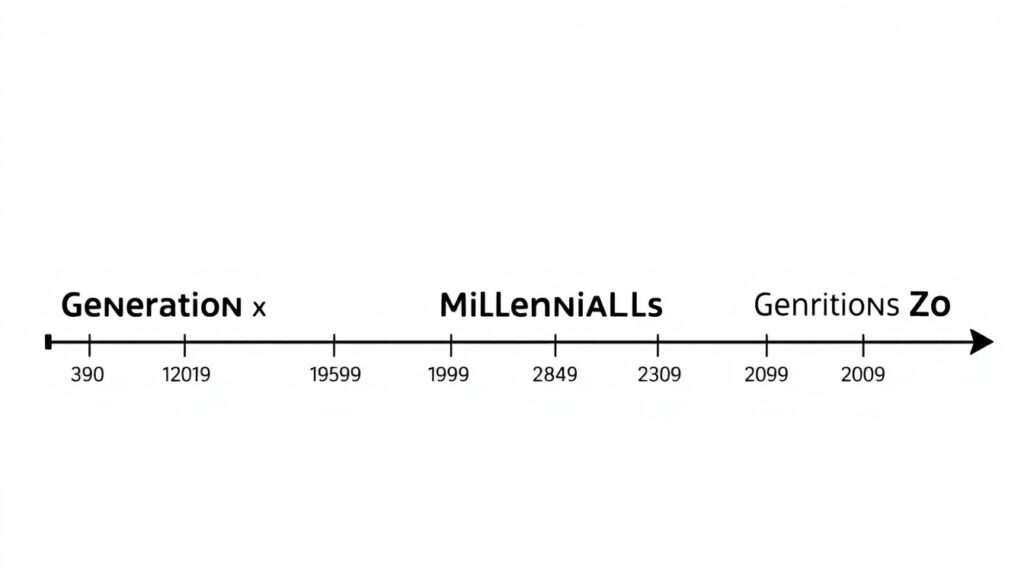
Generation Xyz: Birth Years for Gen X, Millennials, Z
Few things spark as much debate as a simple question: which generation do you belong to? The labels—Gen X, Millennial, Gen Z—are everywhere, but their boundaries are fuzzier than most people realize. According to the Pew Research Center (a nonpartisan fact tank), Millennials are defined as those born between 1981 and 1996, while Gen Z starts in 1997. This article cuts through the confusion to explain what “Generation Xyz” really means and maps out the full generational lineup from the Greatest Generation to Generation Alpha.
Generation X birth years: 1965–1980 ·
Millennial birth years: 1981–1996 ·
Gen Z birth years: 1997–2012 ·
Number of named generations (20th/21st c.): 6 ·
Oldest living generation: The Greatest Generation (born 1901–1927)
Quick snapshot
- Pew Research defines Millennials as born 1981–1996 and Gen Z as born 1997–2012 (Pew Research Center (nonpartisan fact tank))
- Generation Alpha (born 2013–2025) was coined by McCrindle Research (McCrindle Research (social research firm))
- Generation X birth year boundaries vary by source, from 1965–1976 to 1965–1980 (IACET (continuing education accreditor))
- Health and happiness rankings across generations are disputed due to data limitations (Kasasa (consumer finance research))
- Generational labels follow a loose chronological sequence but are not government classifications (Library of Congress (U.S. federal research library))
- The term “Generation X” was popularized in 1991 by Douglas Coupland’s novel (Wikipedia (editorial reference source))
- Generation Alpha (born 2013–2025) is the youngest named cohort; future naming conventions remain uncertain (Repsol (energy company explainer))
- Some sources already speculate about “Generation Beta” for post-2025 births (BBC Bitesize (educational service))
The table below collates the most commonly cited generational boundaries from authoritative sources.
| Fact | Value |
|---|---|
| Pew Research Millennial birth years | 1981–1996 (Pew Research Center (nonpartisan fact tank)) |
| Pew Research Gen Z birth years | 1997–2012 (Pew Research Center (nonpartisan fact tank)) |
| Term “Generation X” popularized | 1991 by Douglas Coupland (Wikipedia (editorial reference source)) |
| Generation Alpha named | Coined by McCrindle Research in 2008 (McCrindle Research (social research firm)) |
| Gen X population (US, 2017 estimate) | Approximately 41 million (IACET (continuing education accreditor)) |
The implication: these numbers come from different years and methodologies, so cross-source comparisons require caution.
Which generation is xyz?
Defining the term Generation Xyz
No official generation named “Generation Xyz” is widely recognized by researchers or demographic institutions. The phrase most likely results from a misspelling or placeholder for Gen X, Gen Y (Millennials), or Gen Z. According to Repsol (energy company explainer), the three letters X, Y, Z are often used together as shorthand for the three most recent adult cohorts.
Common confusion with Gen X and Gen Z
Because the letters X, Y, and Z run sequentially, “Generation Xyz” sometimes appears in informal writing as a catch-all term. The BBC’s educational service notes that Generation Y is frequently called Millennials, but many people still use Gen Y as an alternative label, further muddying the alphabet soup.
If you encounter “Generation Xyz” in a headline or meme, the safest bet is that it refers to the Gen X–Millennial–Gen Z trio collectively — a marketing convenience, not a census category.
What are the next 5 generations called?
Six named generations follow the Greatest Generation in the standard 20th/21st-century timeline. Each label reflects a social or economic turning point rather than a government decree.
- The Greatest Generation (born 1901–1927) – lived through the Great Depression and World War II (BBC Bitesize (educational service))
- The Silent Generation (born 1928–1945) – came of age in the post-war era (Kasasa (consumer finance research))
- Baby Boomers (born 1946–1964) – the post-war baby boom cohort (Repsol (energy company explainer))
- Generation X (born 1965–1980) – the “latchkey” generation, transitional between analog and digital (IACET (continuing education accreditor))
- Millennials (Gen Y) (born 1981–1996) – came of age during the internet boom (Pew Research Center (nonpartisan fact tank))
- Generation Z (born 1997–2012) – digital natives, most diverse generation (Pew Research Center (nonpartisan fact tank))
- Generation Alpha (born 2013–2025) – first fully 21st-century cohort (McCrindle Research (social research firm))
The pattern: each generation spans roughly 15–20 years, and the labels usually come from authors, marketers, or journalists — not from official statistical agencies.
Why are millennials not called Gen Y?
Origin of the name Millennial
The term “Millennial” was coined by authors William Strauss and Neil Howe in their 1987 book Generations, according to Wikipedia (editorial reference source). They wanted a label that captured the cohort’s coming-of-age around the turn of the millennium.
Why Gen Y fell out of favor
Gen Y was an early placeholder in demographic tables — the natural letter after X. But media outlets and researchers preferred the more evocative “Millennial.” BBC Bitesize (educational service) explains that “Gen Y” never disappeared entirely, but it now serves mainly as an alternative shorthand for the same group.
The shift from Gen Y to Millennial illustrates that generational names are branding choices, not fixed scientific terms — a key reason “Generation Xyz” has no single, stable meaning.
Am I Gen Z or millennial?
Birth year ranges
The cut-and-dried answer comes from Pew Research: if you were born between 1981 and 1996, you’re a Millennial; born between 1997 and 2012, you’re Gen Z (Pew Research Center (nonpartisan fact tank)). These boundaries are the most widely cited in journalism and market research.
Key cultural markers
Beyond the year, Tivian (workplace experience platform) notes that Millennials remember a world without ubiquitous smartphones, while Gen Z has always had them. That technology gap often reinforces the birth-year distinction.
What is the most unhealthiest generation?
Health metrics across generations
Studies indicate that Millennials and Gen Z report higher rates of certain health issues such as anxiety and depression compared to older cohorts, according to Kasasa (consumer finance research). However, data on physical health metrics like obesity and chronic disease paint a mixed picture.
Obesity, mental health, and chronic disease data
The Library of Congress (U.S. federal research library) frames generational segmentation as a consumer-research tool, not a medical classification. Without longitudinal data that controls for age and period effects, singling out one “most unhealthy” generation remains speculative.
The implication: while Gen Z and Millennials face real mental health challenges, ranking generations by health is a comparison that depends heavily on which metric you choose — and who funds the study.
Generational timeline
- 1901–1927 — The Greatest Generation (BBC Bitesize (educational service))
- 1928–1945 — The Silent Generation (Kasasa (consumer finance research))
- 1946–1964 — Baby Boomers (Repsol (energy company explainer))
- 1965–1980 — Generation X (IACET (continuing education accreditor))
- 1981–1996 — Millennials (Gen Y) (Pew Research Center (nonpartisan fact tank))
- 1997–2012 — Generation Z (Pew Research Center (nonpartisan fact tank))
- 2013–2025 — Generation Alpha (McCrindle Research (social research firm))
What we know and what’s still fuzzy
Confirmed facts
- Pew Research birth year ranges for Millennials and Gen Z are the most referenced standard (Pew Research Center (nonpartisan fact tank))
- Generation Alpha exists as a named cohort, coined by McCrindle Research (McCrindle Research (social research firm))
- Generational labels are market-research constructs, not official government categories (Library of Congress (U.S. federal research library))
What’s unclear
- Exact boundaries of Generation X vary; some sources end it in 1976, others in 1980 (IACET (continuing education accreditor))
- Health and happiness rankings are disputed because data mixes age and period effects (Kasasa (consumer finance research))
- No consensus exists on what name will follow Generation Alpha (BBC Bitesize (educational service))
Voices on generational labels
Generations are a way of segmenting the population for consumer research and marketing — they are not biologically defined, but they help us understand shared experiences.
— Library of Congress (U.S. federal research library)
The term ‘Generation X’ came from the title of my 1991 novel. I wanted a name for a generation that felt left out of the narratives of the Baby Boomers and the Silent Generation.
— Douglas Coupland, author of Generation X: Tales for an Accelerated Culture (Wikipedia (editorial reference source))
For consumers of generational content — from personality quizzes to workplace seminars — the choice is clear: use the year ranges as a guide, but remember that a label like “Gen X” describes a statistical cluster, not a uniform identity. Or risk getting pinned with a label that, like “Generation Xyz,” means something different to everyone.
cudoo.com, youtube.com, youtube.com, bulbapedia.bulbagarden.net, youtube.com
Frequently asked questions
What is the difference between Gen X and Millennials?
Gen X (born 1965–1980) grew up transitioning from analog to digital; Millennials (born 1981–1996) came of age with the internet. Birth year is the primary differentiator, according to Pew Research Center (nonpartisan fact tank).
What are the birth years for Generation Z?
Pew Research defines Gen Z as those born between 1997 and 2012 (Pew Research Center (nonpartisan fact tank)).
Is there a generation called Gen C?
Gen C is an informal label sometimes used for the “connected generation” of digital natives, but it is not a standard cohort name like Gen X or Gen Z (Tivian (workplace experience platform)).
What is the unhappiest generation?
Surveys often show that Millennials and Gen Z report higher rates of stress and anxiety, but happiness rankings vary by methodology and region. No single generation is universally considered the unhappiest (Kasasa (consumer finance research)).
How many generations are alive today?
As of 2025, seven generations are alive: the Silent Generation, Baby Boomers, Gen X, Millennials, Gen Z, Gen Alpha, and a small number of the Greatest Generation (BBC Bitesize (educational service)).
Which generation has the best marriages?
Data from the Institute for Family Studies shows Millennials have lower divorce rates than Baby Boomers, though Gen X marriages report moderate satisfaction levels (Kasasa (consumer finance research)). No single generation claims the “best” marriages across all measures.
Why is it called Generation X?
The name was popularized by Canadian author Douglas Coupland in his 1991 novel Generation X: Tales for an Accelerated Culture. The “X” was meant to signify an unknown or nameless generation (Wikipedia (editorial reference source)).
What comes after Gen Alpha?
No official name has been widely adopted for the generation born after 2025. Some researchers informally refer to “Generation Beta,” but the label is not yet standardized (McCrindle Research (social research firm)).
More related posts
 Christopher Columbus: Biography, Voyages, Controversy & Facts
 IT Cosmetics CC Cream Review: Best for Mature Skin
 6-7 Meme – Origin Meaning and TikTok Rise
 Highway 11 Closure Today – No Active Closures in Ontario
 Reilly Smith: Biography, Contract & Net Worth Profile
 How to Perfectly Cook Longe de Porc au Four Quebec Style
 15 kg to lbs – The Exact 33.07 Pounds Conversion Guide
 King Kong: Definition, Films, Box Office & Cultural Impact