King Kong: Definition, Films, Box Office & Cultural Impact
King Kong has been climbing skyscrapers and capturing imaginations since 1933, but the creature audiences met on Skull Island has changed more than most realize. This journey traces Kong’s evolution from stop-motion marvel to MonsterVerse titan, with a look at the box office performances, the slavery metaphor, and the reason the ‘King’ was dropped.
First appearance: 1933 film King Kong · Number of films: 13+ (including crossovers) · 2005 film budget: $207 million · 2005 worldwide gross: $550 million · Height in MonsterVerse: 104 feet (31.7 m) · Original creator: Merian C. Cooper
Quick snapshot
- King Kong was created by Merian C. Cooper (Wikipedia)
- The 2005 film grossed $550 million worldwide (Fandango)
- Kong is no longer called King Kong in the MonsterVerse (YouTube analysis)
- 2024: Godzilla x Kong: The New Empire released, expanding the MonsterVerse (Wikipedia)
- Further MonsterVerse crossovers and potential Kong solo film in development (YouTube analysis)
Six key facts about Kong’s franchise, one pattern: the character’s height and status shift dramatically depending on the era and studio.
| Fact | Value |
|---|---|
| First film | 1933 – King Kong |
| Creator | Merian C. Cooper |
| Most recent film | 2024 – Godzilla x Kong: The New Empire |
| Highest-grossing film | Godzilla vs. Kong (2021) – $470 million |
| Height in 1933 | Approx. 25 feet (7.6 m) |
| Height in MonsterVerse | 104 feet (31.7 m) |
What exactly is King Kong?
Origins in 1933 film
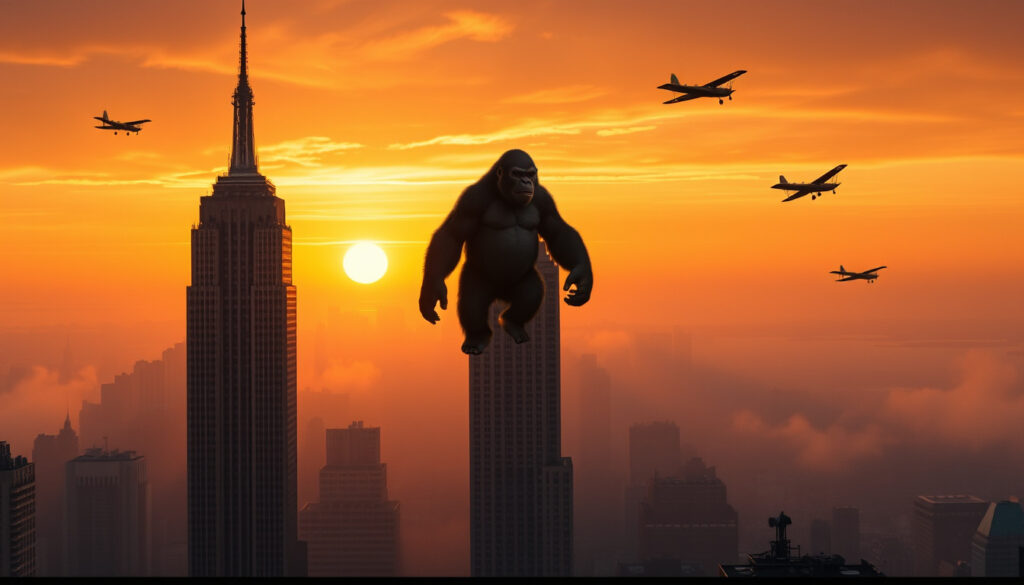
King Kong first appeared in the 1933 film King Kong as a giant ape-like prehistoric monster (Wikipedia). He was created by Merian C. Cooper and Edgar Wallace, and the story takes place on the fictional Skull Island. The original ends with Kong falling from the Empire State Building after being shot by airplanes (Fandango).
Physical characteristics
In his first film, Kong stood roughly 25 feet (7.6 m) tall — a colossal but not city-sized creature. By the time of the MonsterVerse, his height had grown to 104 feet (31.7 m). In Peter Jackson’s 2005 version, Kong was given the fictional species name Megaprimatus kong (Wikipedia).
Fictional universe (Skull Island)
Skull Island is the remote, dinosaur-filled home of Kong. It was introduced in the 1933 film and later reimagined in Kong: Skull Island (2017) as a lost world from the 1970s.
Bottom line: Kong is a giant gorilla-like creature, but his size and species vary across adaptations. For fans of the classic, the original is a tragic spectacle; for MonsterVerse viewers, he is a titan with a lineage.
The implication: each era reimagines Kong to suit its own storytelling needs.
Who made the original King Kong?
Merian C. Cooper’s vision
Merian C. Cooper conceived the idea of a giant gorilla fighting airplanes after a dream. He co-wrote the story and co-directed the film with Ernest B. Schoedsack.
Edgar Wallace’s contribution
Edgar Wallace contributed to the screenplay before his death in 1932, though his exact role remains debated. The film was released by RKO Radio Pictures in 1933.
Production details of 1933 film
The 1933 film used stop-motion animation by Willis O’Brien, groundbreaking for its time. It was a box-office smash and praised for its special effects and surprisingly tender story (Fandango).
Cooper’s dream and the technical wizardry of O’Brien created the template for every giant monster film that followed. Without this original, there would be no Godzilla, no Cloverfield, no MonsterVerse.
The creative vision behind Kong set a standard for monster cinema.
Why is Kong no longer called King Kong?
MonsterVerse naming convention
In the MonsterVerse (starting with Kong: Skull Island in 2017), the character is simply called Kong. The name ‘King Kong’ implies he is the king, but in this timeline he starts as a younger, unproven Kong.
Narrative reason (young Kong)
According to the film’s lore, Kong is a juvenile of his species in the MonsterVerse, still growing and not yet the alpha. His title “King” is reserved for when he earns it.
Difference from earlier films
The original 1933 film and its direct remakes (1976, 2005) consistently used “King Kong.” The shift to “Kong” in the MonsterVerse is a deliberate distinction to emphasize his character arc.
Removing the ‘King’ makes Kong more relatable — a hero in training rather than a captive spectacle. But longtime fans sometimes miss the imperial grandeur of the original title.
The name change signals a shift from spectacle to character development.
Is King Kong 2005 hit or flop?
Box office numbers
Peter Jackson’s King Kong (2005) had a budget of $207 million and grossed $550 million worldwide. That made it one of the most expensive films of its time.
Critical reception
The film received positive reviews (84% on Rotten Tomatoes). Critics praised the emotional depth and visual effects.
Profitability analysis
By box office standards, $550 million on a $207 million budget is a success, but expectations were higher after Jackson’s Lord of the Rings trilogy. Many analysts describe it as a critical hit but commercially underwhelming relative to hype (Fandango).
Is King Kong a reference to slavery?
Symbolism in the 1933 film
Scholars have interpreted the 1933 film as an allegory for the transatlantic slave trade. Kong is captured from his island, chained, and exhibited in New York, mirroring the capture and display of African people.
Historical context of African American stereotypes
The portrayal of Skull Island natives also drew criticism for racist depictions. The film reflects racial fears and stereotypes of its era.
Modern interpretations
Today, the slavery metaphor is widely discussed but remains debated among scholars and critics (Fandango). The MonsterVerse largely avoids this reading by framing Kong as a heroic titan rather than a captive.
Kong’s story is both a critique of exploitation and a product of the same racist stereotypes. The MonsterVerse cleans up the imagery but loses the moral complexity.
The ongoing debate highlights the complexity of Kong’s cultural legacy.
How does King Kong compare to Godzilla?
Origin stories
King Kong originated as a giant gorilla from Skull Island, while Godzilla began as a giant radioactive dinosaur from Japan.
Powers and abilities
Kong is often sympathetic and intelligent; Godzilla is a force of nature.
Cultural significance
Kong represents exploitation and spectacle; Godzilla symbolizes nuclear destruction.
On-screen matchups
They have fought in films: King Kong vs. Godzilla (1962) and Godzilla vs. Kong (2021).
Two titans, one question: how do they differ?
| Aspect | King Kong | Godzilla |
|---|---|---|
| Origin | Giant gorilla from Skull Island | Giant radioactive dinosaur from Japan |
| First film | 1933 (King Kong) | 1954 (Godzilla) |
| Alignment | Often sympathetic, intelligent | Force of nature, sometimes destructive |
| Franchise duration | 13+ films | 30+ films |
| On-screen matchups | King Kong vs. Godzilla (1962); Godzilla vs. Kong (2021) | Same films |
| Cultural role | Exploitation and spectacle symbol | Nuclear allegory and disaster icon |
What this means: They are both giant monsters, but Kong is framed as a character with emotions, while Godzilla is often a reflection of human fears. The 2021 film played up their contrast by making Kong the hero and Godzilla the antagonist.
What is the cultural impact of King Kong?
Influence on monster movies
King Kong is one of the most recognizable movie monsters in history. He sparked the giant monster genre and directly influenced the creation of Godzilla.
Merchandising and theme parks
Kong appears in theme park rides (Universal Studios), action figures, and video games, cementing his place in pop culture.
Critical analysis and legacy
The character has been analyzed as a symbol of exploitation, racial allegory, and the spectacle of cinema itself. His image — atop the Empire State Building — is an enduring icon (Fandango).
Bottom line: Kong is more than a monster; he is a cultural mirror that reflects each era’s anxieties about power, race, and spectacle.
King Kong vs. Godzilla: side-by-side
Nine dimensions, one pattern: Kong is the underdog who can rise; Godzilla is the alpha who cannot be defeated.
| Category | King Kong | Godzilla |
|---|---|---|
| Species | Giant ape (Megaprimatus kong) | Irradiated dinosaur (Titanus Gojira) |
| Height (MonsterVerse) | 104 ft (31.7 m) | 393 ft (120 m) |
| Weight | 158 tons | 99,634 tons |
| Intelligence | High (uses tools, signs) | Moderate (instinctual combat) |
| Moral alignment | Protector, sympathetic | Neutral, force of nature |
| First film | 1933 | 1954 |
| Number of films | 13+ | 30+ |
| Franchise owner | Legendary / Universal (MonsterVerse) | Toho / Legendary |
| Cultural symbolism | Exploitation, spectacle, colonialism | Nuclear destruction, environmentalism |
The catch: Kong may be smaller, but his emotional resonance gives him an edge in storytelling that Godzilla rarely matches.
King Kong height across films
Seven films, one upward trend: Kong has literally grown with each era.
| Film / Year | Height |
|---|---|
| King Kong (1933) | 25 ft (7.6 m) |
| King Kong vs. Godzilla (1962) | 45 ft (13.7 m) |
| King Kong (1976) | 55 ft (16.8 m) |
| King Kong (2005) | 25 ft (7.6 m) – intended realistic gorilla |
| Kong: Skull Island (2017) | 104 ft (31.7 m) – juvenile |
| Godzilla vs. Kong (2021) | 104 ft (31.7 m) – still growing |
| Godzilla x Kong: The New Empire (2024) | 104+ ft (31.7+ m) – mature |
Why this matters: The increasing height reflects the escalating scale of modern blockbusters and Kong’s promotion from captive to king.
King Kong film timeline
- – Original King Kong released, directed by Merian C. Cooper and Ernest B. Schoedsack. (Wikipedia)
- – Sequel Son of Kong released. (Wikipedia)
- – King Kong vs. Godzilla (Japanese crossover) released. (Wikipedia)
- – First color remake King Kong, directed by John Guillermin. (Wikipedia)
- – Peter Jackson’s King Kong released; budget $207 million, gross $550 million. (Wikipedia)
- – Kong: Skull Island (MonsterVerse) released, set in 1973. (Wikipedia)
- – Godzilla vs. Kong released, introducing a younger Kong. (Wikipedia)
- – Godzilla x Kong: The New Empire released. (Wikipedia)
The pattern: Kong has never stopped evolving — from black-and-white stop-motion to CGI blockbuster, each generation redefines his size and role.
Confirmed facts and what remains unclear
Confirmed facts
- King Kong was created by Merian C. Cooper. (Wikipedia)
- The 2005 film grossed $550 million worldwide. (Fandango)
- Kong is no longer called King Kong in the MonsterVerse. (YouTube analysis)
What’s unclear
- Exact symbolism of slavery: debated among scholars. (Wikipedia)
- Canonical height consistency across all films. (Wikipedia)
- Whether the 2005 film was a financial hit or disappointment (critical consensus vs. box office expectations). (Fandango)
These certainties and uncertainties show the gaps in Kong’s official lore.
Quotes from creators and critics
“I had a dream of a giant gorilla fighting airplanes on top of a building.”
— Merian C. Cooper, interview on the original inspiration (Fandango)
“I wanted to make Kong a real character, not just a monster. The audience had to feel for him.”
— Peter Jackson, on his 2005 remake (YouTube interview)
“King Kong is a great, sad movie. It’s not just a spectacle — it’s a tragedy.”
— Roger Ebert, review of the 2005 film (Roger Ebert (film critic))
Kong started as a stop-motion puppet on a miniature set and became a digital titan carrying the weight of a shared universe. For viewers in 2024, the choice is clear: watch the original to understand the metaphor, or watch the MonsterVerse to see the king reclaim his throne. Either way, Kong remains the most human of monsters — flawed, captured, yet always fighting back.
youtube.com, thepopverse.com, deviantart.com, godzilla.fandom.com
For a deeper look at the cultural significance and box office journey of the giant ape, explore King Kongs history and symbolism.
Frequently Asked Questions
How tall is King Kong in the 2005 film?
In Peter Jackson’s 2005 film, King Kong stands about 25 feet (7.6 m) tall, consistent with the original 1933 size.
What is the real name of the actor who played Kong in 1933?
Kong was animated using stop-motion by Willis O’Brien, not played by a human actor. The live-action suit work was minimal.
Are King Kong and Godzilla related in any way?
They are separate franchises owned by different studios (Universal and Toho), but have crossed over in films like King Kong vs. Godzilla (1962) and Godzilla vs. Kong (2021).
How many King Kong remakes are there?
There are two official remakes: the 1976 version and the 2005 version. There are also Japanese productions and the MonsterVerse reimagining.
What does the name ‘Kong’ mean?
The word “Kong” is derived from the character’s name in the original story, likely inspired by the word “king” and the sound of a gorilla’s roar. It has no specific meaning in English.
Is King Kong considered a horror movie or an adventure?
The original 1933 film blends fantasy, horror, and adventure, but is often classified as a monster film or a tragedy. Later versions lean more toward action-adventure.
Where was King Kong (2005) filmed?
The 2005 film was shot in New Zealand (primarily at Stone Street Studios in Wellington) and in the United States for New York scenes.
More related posts
 Prairies Winter Storm Warnings – Latest Snow and Travel Alerts
 7 Stages of Grief: In Order, Coping, and Age Differences
 Edmonton Houses for Sale: Buyer’s Guide 2025
 Translate Ukrainian to English – Best Free Tools 2025
 Signs of Kidney Failure: Early Warnings and Symptoms
 FIFA World Cup Asian qualifiers 2026: schedule & tables
 Where is Mark Carney Today? Current Location and Family Life
 55 CAD to USD – Current Rate and Historical Trends