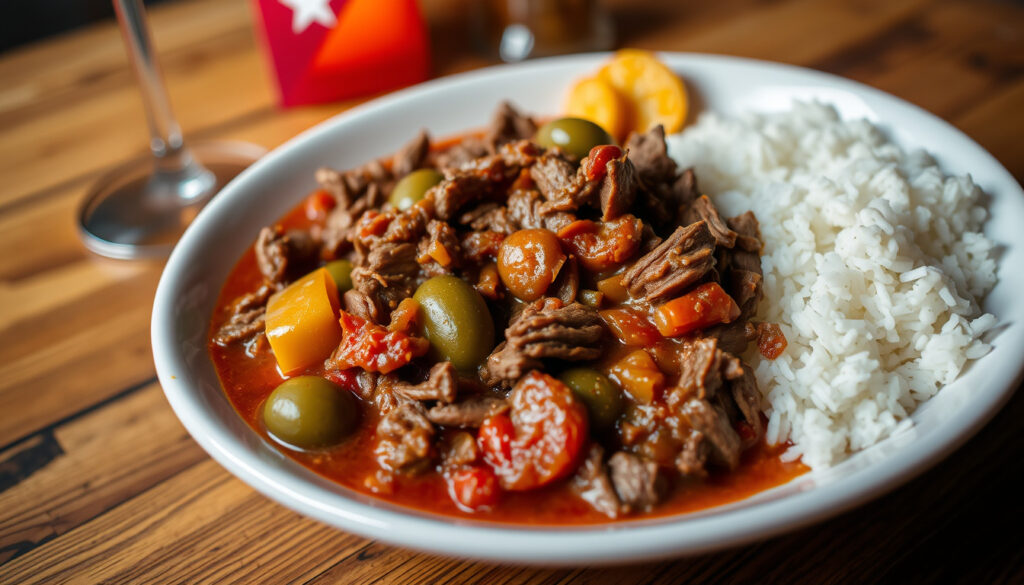
Best Ropa Vieja Cubana Near Me: Cuts, Recipes & Local Spots
There’s something about a plate of ropa vieja that feels like a warm welcome – tender shredded beef swimming in a savory tomato sauce, served with rice and beans. But if you’re searching for the best ropa vieja cubana near you, knowing what to look for can make all the difference – by combining recipe knowledge with restaurant-finding tips, you can spot the real deal every time.
Calories per serving (USDA): 285 kcal · Protein per serving: 26 g · Total fat per serving: 16 g · Saturated fat: 5 g · Sodium per serving: 550 mg · Total carbohydrates: 8 g
Quick snapshot
- Ropa vieja is considered Cuba’s national dish (Encyclopaedia Britannica)
- The name means “old clothes” in Spanish (Encyclopaedia Britannica)
- A 3 oz serving has 285 calories, 26 g protein, 16 g fat (USDA FoodData Central)
- Exact origins – whether the dish originated in Spain or Cuba is debated (Encyclopaedia Britannica)
- Health impact varies significantly by preparation and portion size (USDA FoodData Central)
- Earliest recorded versions trace to the Canary Islands in the 19th century (Encyclopaedia Britannica)
- Brought to Cuba by Spanish colonizers and adapted with local ingredients (Encyclopaedia Britannica)
- Search for authentic ropa vieja using Yelp or Google Maps (Tripadvisor)
- Look for Cuban restaurants that feature slow-braised shredded beef (Havana Heights)
- Explore other Latin comfort foods like Best Pastelón Near Me
Six key facts about ropa vieja, from its disputed origin to its nutritional profile.
| Label | Value |
|---|---|
| Origin | Cuba (disputed with Spain) |
| Main ingredient | Flank or skirt steak |
| Cooking method | Slow braising (stovetop or slow cooker) |
| Average calories | 285 per 3 oz serving (USDA) |
| Sodium per serving | 550 mg |
| Popularity | Considered Cuba’s national dish |
What is the best cut of meat for ropa vieja?
Why flank steak is preferred
“Flank steak is the ideal cut because it shreds beautifully and stays moist.”
Serious Eats
Flank steak, a lean cut from the abdominal muscles, has long been the traditional choice for ropa vieja. Its long grain structure separates easily during the long, slow braise, creating the dish’s signature shredded texture (Encyclopaedia Britannica (Cuban cooking traditions)).
Skirt steak as an alternative
Skirt steak, cut from the plate, offers a similar grain but with more marbling. Chefs often reach for it when flank steak is unavailable. The extra fat adds richness, though the texture can be slightly chewier (Havana Heights (restaurant menu description)).
Can you use chuck or brisket?
Tougher cuts like chuck or brisket work well too, but require a longer braise – up to three hours – to break down connective tissue. The result is a more robust beef flavor, but the shredding may be less uniform (CubaNu Restaurant & Lounge (slow-cooked method)).
Flank steak delivers the classic texture but can be expensive; skirt steak sacrifices a little tenderness for a deeper beefy taste. Budget-conscious cooks may prefer chuck, which becomes fork-tender after a long braise but requires more time.
The pattern: each cut trades tenderness for flavor intensity, and the cook’s priority determines the best choice.
Is ropa vieja Cuban or Venezuelan?
Origins in the Canary Islands and Spain
The earliest recorded versions of ropa vieja appear in 19th-century Spanish cookbooks from the Canary Islands, where it was a way to use leftover beef (Encyclopaedia Britannica (culinary history)). Colonists brought the recipe to Cuba, where it evolved with local ingredients.
Cuba’s national dish status
Cuba officially adopted ropa vieja as its national dish, and it remains a staple in homes and restaurants across the island (Encyclopaedia Britannica (cultural designation)). The Cuban version is characterized by a tomato-based sofrito sauce, green bell peppers, and a pronounced cumin note.
Venezuelan version and differences
Venezuela has a similar dish called carne mechada, which uses shredded beef but often incorporates black beans and a different spice profile (Tripadvisor (user reviews comparing Latin dishes)). The distinction matters: if you’re seeking Cuban ropa vieja near you, check the menu for terms like “Cuban-style” or “ropa vieja cubana.”
Ropa vieja is universally recognized as Cuban today, but its genetic roots are Spanish. Restaurants that claim the “most authentic” version may actually be serving a Canarian ancestor – and that’s fine, as long as the sofrito tastes right.
The implication: when you order ropa vieja, you are eating a dish that crossed an ocean and adapted to a new culture — the Cuban identity is what defines it today.
Is ropa vieja healthy?
Nutritional breakdown from USDA
According to the USDA FoodData Central (authoritative food database), a 3 oz serving of ropa vieja made with flank steak contains 285 calories, 26 g protein, and 16 g fat, of which 5 g is saturated. Sodium runs about 550 mg, largely from the tomato sauce and seasonings.
Healthiest cuts of beef for ropa vieja
Flank steak is naturally leaner than many alternatives. Choosing it over chuck reduces saturated fat by roughly 30% (USDA Food Safety and Inspection Service (meat composition guidance)). Skirt steak falls in between.
How to make a lighter version
Use less oil in the sofrito, drain excess fat after browning the beef, and serve with a heap of vegetables instead of white rice. The FDA (food safety guidance) recommends keeping cooked beef above 140°F if serving immediately, and chilling leftovers within two hours.
What is the most popular Cuban food?
Ropa vieja’s place at the top
Ropa vieja consistently ranks as the most searched Cuban dish on platforms like Yelp and Tripadvisor (Tripadvisor (New York City Cuban restaurant rankings)). It appears on nearly every Cuban restaurant menu, from New York’s Victor’s Cafe to local spots in Miami.
Other classic Cuban dishes
Lechón asado (roast pork), picadillo (ground beef hash), and arroz con pollo are also beloved. But ropa vieja holds the crown for its unique shredded texture and deep umami flavor.
What makes Cuban cuisine unique
Cuban cooking blends Spanish, African, and Caribbean influences. The heavy use of sofrito, citrus marinades (mojo), and slow-braising sets it apart from other Latin cuisines (Encyclopaedia Britannica (Cuban culinary heritage)).
What gives ropa vieja its signature flavor?
The role of sofrito
Sofrito – a sautéed base of onion, green bell pepper, and garlic – builds the foundation. Without it, ropa vieja loses its aromatic backbone (Cuba Restaurant & Rum Bar (menu description)).
Key spices: cumin, oregano, bay leaf
Cumin and oregano are non-negotiable. A single bay leaf added during the braise infuses the sauce with a subtle herbal note. The tomato sauce, often from crushed tomatoes, provides acidity that balances the richness of the beef.
Slow cooking and browning techniques
The beef is first seared to develop Maillard reaction flavors, then simmered for 90 minutes to two hours until fork-tender. The long braise allows the sauce to penetrate every fiber – that’s what creates the signature dark, savory hue (USDA FSIS (braising temperature recommendations)).
Three common cuts, one pattern: each brings a different balance of tenderness and beefy flavor.
| Cut | Texture after braise | Flavor intensity | Best use |
|---|---|---|---|
| Flank steak | Clean, uniform shredding | Mild to medium | Authentic ropa vieja |
| Skirt steak | Slightly chewier shreds | Rich, beefy | Flavor-focused versions |
| Chuck / brisket | Very tender, may fall apart | Robust, deep | Budget-friendly alternatives |
The implication: if you prioritize texture, go with flank steak. For bold beef taste, skirt steak wins. Chuck is the workhorse when you’re feeding a crowd without breaking the bank.
How to cook ropa vieja at home (step by step)
- Brown the beef – Season 1½ lbs flank steak with salt and pepper. Sear in a hot pot with oil until deeply browned on all sides (USDA FSIS (safe browning temperatures)).
- Sauté the sofrito – In the same pot, cook 1 diced onion, 1 bell pepper, and 4 cloves minced garlic until soft.
- Add spices and liquid – Stir in 2 tsp cumin, 1 tsp oregano, 1 bay leaf, and 1 can crushed tomatoes (Encyclopaedia Britannica (traditional braise)).
- Braise low and slow – Return the beef to the pot, add ½ cup beef broth, bring to a simmer, then cover and cook on low for 1½–2 hours until tender.
- Shred and finish – Remove the beef, shred with two forks, return to the sauce, and simmer uncovered for 10 minutes to thicken.
The pattern: each step builds flavor sequentially – browning creates depth, sofrito adds sweetness, and the long braise bonds everything together.
Confirmed facts
- Ropa vieja is Cuba’s national dish (Encyclopaedia Britannica)
- USDA data: 285 kcal, 26 g protein per 3 oz serving (USDA FoodData Central)
- Flank steak yields the most authentic shredding (Encyclopaedia Britannica (Cuban cooking traditions))
- Slow braising at low temperature is the definitive method (USDA FSIS)
What’s unclear
- Exact origin: Spain vs. Cuba (Encyclopaedia Britannica)
- Nutritional consistency across restaurant preparations (USDA FoodData Central)
- Whether skirt steak or flank steak is truly more traditional (Havana Heights)
“It is commonly said to have originated in the Canary Islands before making its way to Cuba.”
Wikipedia
“Nutritional data for 3 oz of ropa vieja: 285 kcal, 26 g protein.”
USDA Food and Nutrition Service
For anyone searching best ropa vieja cubana near me, the choice is clear: focus on restaurants that slow-braise their beef until it shreds effortlessly, and verify authenticity through menu descriptions and reviews. Otherwise, you risk getting a version that’s closer to a generic beef stew than the real Cuban classic.
Frequently asked questions
Can I make ropa vieja in a slow cooker?
Yes. After browning the beef and sofrito, transfer everything to a slow cooker and cook on low for 6–8 hours. The result is tender, shreddable beef (Encyclopaedia Britannica (cooking variations)).
What are traditional side dishes for ropa vieja?
White rice, black beans, fried plantains, and a side of crusty bread are classic. Many Cubans also serve a simple green salad. If you enjoy baking, try a No Knead Bread Recipe to accompany the meal.
Is ropa vieja gluten-free?
Yes, as long as the tomato sauce and spices are certified gluten-free. Always check labels on canned tomatoes and broth (FDA (allergen labeling guidance)).
How long does ropa vieja last in the refrigerator?
Properly stored in an airtight container, it will keep for 3–4 days. Reheat gently on the stovetop or microwave (CDC (food safety storage guidelines)).
Where can I buy ropa vieja near me?
Search for “Cuban restaurant” on Yelp or Google Maps. Look for places that list “ropa vieja cubana” on their menu – a sign they honor the traditional recipe (Tripadvisor (Cuban restaurant directories)).
Can I freeze leftover ropa vieja?
Yes. Let it cool completely, then freeze in a sealed container for up to 3 months. Thaw overnight in the fridge before reheating (USDA FSIS (freezing safety)).
What type of rice is best with ropa vieja?
Medium-grain white rice is standard in Cuba. For a healthier twist, use brown rice or cauliflower rice.
More related posts
 Best Whole House Water Filter Systems for Irish Homes
 1 CAD to INR Today: Live Rate, Fees & Conversion Guide
 Kaia Gerber’s Dating History & Relationships Timeline
 Prairies Winter Storm Warnings – Latest Snow and Travel Alerts
 No Knead Bread Recipe: 2-Hour & 24-Hour Methods
 When Does Daylight Savings Time End 2025 – Nov 2 at 2 a.m.
 PR Processing Time Canada – Current IRCC Timelines 2025
 Dylan Minnette: Why He Quit Acting, Age, Height, Band & More