Skip Hop Activity Centre: Age, Safety & Features Guide
You’ve probably seen the Skip Hop Activity Centre in every baby registry list and wondered if it’s worth the hype, but beyond the bright toys and 360° seat lies a more practical question: does it actually fit your baby’s development stage and your safety standards? This guide walks through the age guidelines, safety considerations, and how the 3-stage design grows with your child — so you can decide with confidence.
Age range: 4 months and up · Number of stages: 3 · Seat feature: 360° rotating, full body support · Conversion: Sit-in activity center to play table to toddler table
Quick snapshot
- Designed for babies 4 months and up (Target (retailer listing))
- 3-stage convertible: sit-in → play table → toddler table (Babylist (registry guide))
- Stationary seat (no bouncing) (Target (retailer listing))
- Exact weight limit for stages 2 and 3 not specified in available inputs
- Warranty period not found in provided sources
- Whether specific pediatricians endorse this model over alternatives
- Whether the product meets specific ASTM safety standards (not explicitly stated in sources)
- Dimensions for toddler table stage not available
- Official battery life estimate not provided
- Use from 4 months to toddler years (Babylist (registry guide))
- Most outgrow seat by 9-12 months (Babylist (registry guide))
- Converts to play table for independent play (Carter’s (children’s retailer))
Three key numbers define this product: one convertible design, three stages, and a 360° rotating seat that keeps your baby engaged from every angle.
| Spec | Value |
|---|---|
| Brand | Skip Hop |
| Product | Baby Activity Centre (Explore & More 3-Stage) |
| Age Range | 4 months to 3 years (toddler) |
| Number of Stages | 3 |
| Seat Rotation | 360° |
| Conversion | Activity center → Play table → Toddler table |
What is a skip hop activity center?
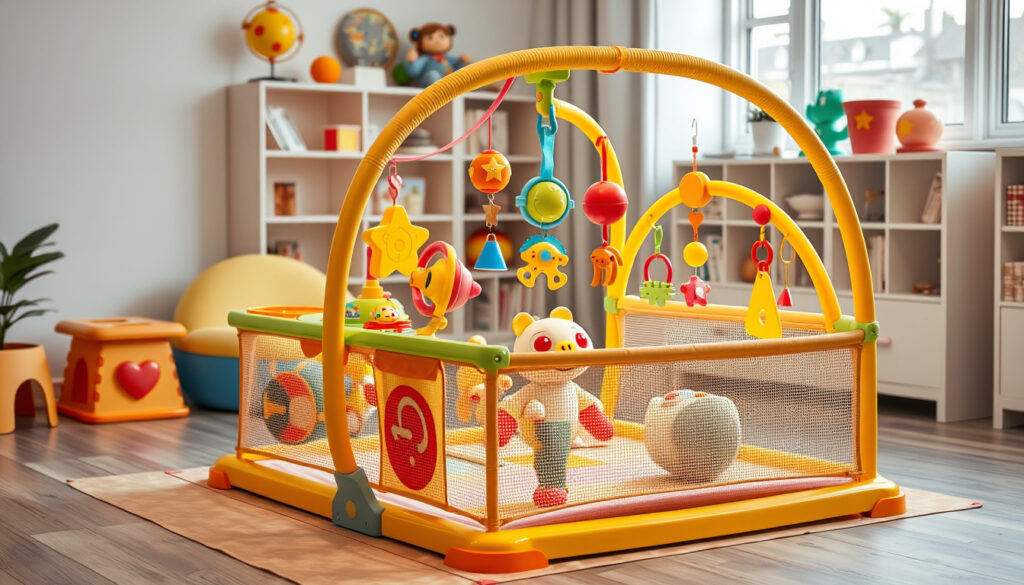
The Skip Hop Explore & More 3-Stage Activity Center is a convertible baby station built to adapt as your child outgrows each stage. According to Target (retailer listing), it starts as a sit-in activity center with a full-body support seat that rotates 360 degrees, giving your baby access to 25+ developmental toys. Stage 2 turns it into a play table with legs so your child can cruise and interact while standing. In Stage 3 the leg panels detach and it becomes a toddler table — a spot for coloring, snacks, or puzzles.
How does the Skip Hop Activity Centre work?
The seat swivels freely, and a Discovery Window lets your baby see the piano toy and their own feet during play (Target (retailer listing)). The base is stationary — no spring or bounce mechanism — which means your baby’s legs rest on the floor tray, not dangling. This design encourages weight-bearing on the legs without the uncontrolled bouncing that jumpers create.
What are the key features?
- 25+ developmental toys, including a piano with lights, spinning beads, and a mirror
- 360° rotating seat with full body support
- 3-stage convertible system (sit-in, play table, toddler table)
- Requires 3 AAA alkaline batteries (not included) (Target (retailer listing))
- Phthalate-free materials (Babylist (registry guide))
The stationary seat is a deliberate trade-off: it trades the bouncing fun of a jumper for safer leg positioning, which matters for hip and foot development.
The implication: parents who prioritize safety over bounce will find this design aligned with pediatric recommendations.
When can babies start using the skip hop activity center?
The product is labeled for ages 4 months and up (Target (retailer listing)). But the real answer depends on head control, not just age. A baby needs strong neck and trunk muscles to sit upright in the support seat — without slumping — for safe use.
Can a 3 month old sit in an activity center?
No. At 3 months, most babies lack the head control to keep their airway open in an upright seat. Putting a 3-month-old in an activity center increases the risk of positional asphyxiation. The American Academy of Pediatrics advises waiting until a baby can hold their head steady — typically around 4 months.
“Limit use to 15–20 minute sessions and ensure proper head support.” — American Academy of Pediatrics (AAP) guidelines on baby activity centers
Can my 4 month old go in an activity center?
Yes — provided your baby has good head control. The product itself is designed for 4 months and up (Babylist (registry guide)), but always check that their head doesn’t bob or tilt forward. Limit each session to 15 to 20 minutes, and never leave your baby unsupervised.
Even with good head control, excessive container time can delay motor milestones. Pediatric guidelines recommend no more than 20 minutes per day in any stationary activity center.
What this means: safe use hinges on developmental readiness, not just the boxed age range.
Is the Skip Hop Activity Center recommended by pediatricians?
Skip Hop states the product was designed in collaboration with a pediatrician (Target (retailer listing)). That doesn’t mean every pediatrician endorses it over other brands, but the design choices — stationary seat, full support, and convertible stages — align with many safety recommendations from the American Academy of Pediatrics.
“Safety standards for stationary activity centers include stability and entrapment prevention.” — Consumer Product Safety Commission (CPSC)
Do pediatricians recommend baby activity centers in general?
Pediatricians often caution against prolonged use of any baby container, including activity centers, walkers, and bouncers, because they can restrict natural movement and delay milestones such as crawling and standing. The stationary design of the Skip Hop reduces some risks — for example, there’s no bouncing that could strain leg joints — but the general caution about limited use still applies.
Are baby jumpers safe?
Baby jumpers (with springs or bouncers) have been linked to toe-walking, delayed crawling, and falls. The American Academy of Pediatrics advises against using mobile baby jumpers. Because the Skip Hop Activity Centre is stationary, it avoids the specific risks that come from bouncing. Yet the same time limit guidelines still hold: use it sparingly and prioritize floor-based play.
Does the Skip Hop Activity Centre bounce?
No. The seat is stationary (Target (retailer listing)). Your baby’s feet rest on the floor tray, and the seat rotates but does not bounce or spring. This is a key differentiator from baby jumpers and exersaucers that incorporate a bouncy mechanism.
Does it replace a jumper?
Not exactly. A jumper lets babies push off the floor and bounce, which provides a different kind of sensory feedback and leg exercise. The Skip Hop focuses on upright standing support and 360-degree engagement with toys. If your baby loves bouncing, they might miss that sensation. But for parents worried about the safety concerns of jumpers, the stationary seat is a safer alternative.
What is the difference between an activity center and a jumper?
Here’s how the two types compare on key features.
| Feature | Activity Center (Skip Hop) | Baby Jumper |
|---|---|---|
| Movement | Stationary (no bounce) | Bouncing via springs or straps |
| Leg positioning | Feet on floor tray, stable | Dangling or pushing down |
| Developmental impact | Supports standing, rotating | May encourage toe-walking |
| Safety recommendation | Limit to 20 minutes per session | Often advised against by pediatricians |
The pattern: a stationary seat trades bounce for controlled leg loading, which aligns with safer developmental outcomes.
Are Exersaucers Bad for Babies?
Exersaucers and related activity centers have been criticized for encouraging toe-walking and delaying independent sitting and crawling. The Skip Hop, being stationary and offering a 360° seat, encourages your baby to pivot and reach rather than bounce. That said, the same container-time caution applies: 15 to 20 minutes per session, and not as a replacement for tummy time or floor play.
How does the Skip Hop compare to exersaucers?
- Exersaucers often have a bouncy seat; Skip Hop does not.
- Skip Hop converts to a play table and toddler desk; most exersaucers do not.
- Skip Hop’s seat rotates fully, while many exersaucers have fixed seats.
What are the pros and cons?
A single product, two sides: the features that help development can also hinder it if used excessively.
Upsides
- 3-stage conversion grows with child up to 3 years
- 360° rotating seat supports reaching and twisting (Target (retailer listing))
- Stationary seat reduces bouncing risks
- Designed in collaboration with a pediatrician (Target (retailer listing))
- Phthalate-free and machine-washable seat (Babylist (registry guide))
Downsides
- Requires 3 AAA batteries (not included) (Target (retailer listing))
- Maximum weight and height limits (25 lb / 30 in) mean shorter usage in stage 1 (Target (retailer listing))
- Stationary design may not satisfy babies who want to bounce
- Container time still limited per pediatric advice
- Assembly required and dimensions (31″ wide) demand floor space (Target (retailer listing))
The catch: even the best design can’t replace unrestricted floor time for motor development.
What’s clear and what’s not
After reviewing the available specifications and guidelines, some aspects are well documented while others remain open.
Confirmed facts
- Minimum age: 4 months (Babylist (registry guide))
- Maximum weight: 25 pounds, max height 30 inches (Target (retailer listing))
- Three stage conversion from sit-in to toddler table
- Stationary seat (no bounce)
- 25+ activities and includes piano toy
- Phthalate-free and machine washable seat pad (Babylist (registry guide))
What’s unclear
- Exact weight limit for stages 2 and 3
- Warranty period and replacement part availability
- Direct pediatrician endorsements specific to this model
- Official battery life estimate
- Dimensions for toddler table configuration
The pattern: most safety-critical data is available, but long-term durability and stage-specific limits need further clarification.
Summary
For parents looking for a safe, convertible activity station, the Skip Hop Activity Centre offers a thoughtful trade-off: it sacrifices the bouncing fun of a jumper for a stationary seat that supports upright play and milestone-friendly positioning. The 3-stage design extends its usefulness far beyond most exersaucers, but the real variable is how you use it. For parents prioritizing developmental safety, the choice is clear: use it as a short-burst enrichment tool — never a daycare substitute — and let floor time remain the star of your baby’s play routine.
Frequently asked questions
Does the Skip Hop Activity Centre require batteries?
Yes, the piano toy requires 3 AAA alkaline batteries (not included) (Target (retailer listing)).
How to clean the Skip Hop Activity Centre?
The seat fabric is machine washable, and some toy components are dishwasher-safe (Babylist (registry guide)). Wipe the plastic frame with a damp cloth.
Is the Skip Hop Activity Centre suitable for twins?
It is designed for a single child. Twin families would need two separate units, and the footprint (31″ by 31″) may require ample space.
Can the Skip Hop Activity Centre be used outdoors?
The product is designed for indoor use. Outdoor exposure to moisture or direct sunlight could damage the toys and seat fabric.
What is the price range for the Skip Hop Activity Centre?
Pricing varies by retailer, but it typically ranges between $80 and $110 USD depending on sales and bundles.
Does the Skip Hop come with toys included?
Yes, it includes more than 25 activities such as a piano with lights, spinning roller, mirror, and bead chaser (Target (retailer listing)).
How to assemble the Skip Hop Activity Centre?
Assembly requires attaching the legs, seat pad, and toy bar. The included manual provides step-by-step instructions. Most users report 20–30 minutes assembly time.
What is the weight limit for the Skip Hop Activity Centre?
The maximum weight for the sit-in stage is 25 pounds (Target (retailer listing)). For the toddler table stage, the product functions as a table so weight limit is not specified.
More related posts
 Gamification Summit Ticket Sale Effectiveness: Top Strategies
 7 Stages of Grief: In Order, Coping, and Age Differences
 Best Whole House Water Filter Systems for Irish Homes
 Google Snake Game: How to Play, Variants & Tips
 Grow a Garden Pet Values – Safe Plants and Key Benefits
 Early Signs of Pregnancy: When Symptoms Appear & How to Know
 Highway 11 Closure Today – No Active Closures in Ontario
 Desjardins Credit Card Guide: Compare Fees, Rewards & More